Mentored by Patrick Tayler
Alongside our self-awareness, imagination, and opposable thumbs, asking questions is one of those seemingly banal abilities that makes humanity unique.[1] It may be appropriate to approach art, another unique achievement of our species, by asking questions.
Being there on the closing day of Woman’s Quota 02, during the exhibition showcase of the Hungarian National Bank’s collection,[2] it might not even have been the “WHY IS THIS ART?” inscription facing the entrance that suggested I was at the then-most self-reflective show of the Palace of Arts (Müpa). Even experts rarely ask themselves such fundamental questions – unlike László Beke, who began his 1985 textbook with the question “WHAT IS ART?”[3]
But let us look at our present: we are surrounded by absurd political situations, volatile economic conditions, and the absence of long-term ecological strategies. In an age riddled with question marks, it is telling that instead of focusing on any of the above – as countless contemporary art shows do – this exhibition directs our attention to itself. This may even indicate that, in the best-case scenario, there is something at stake in our broad relationship with contemporary art.
This may be especially true if we view the museum as a kind of classroom and consider education a basic necessity. Starting in the 1990s – interconnected with the discourse on reinterpreting the concept of the museum, peaking around the 2000s and still noticeable today – the educational role of this type of institution has become more prominent. Sociologist Tony Bennett wrote about the social role of museums as mediators of norms,[4] while George E. Hein discussed learner-centred exhibitions,[5] and Eilean Hooper-Greenhill emphasised the importance of communication with visitors.[6] We could even mention a more illustrious – albeit ultimately unrealised – project, when the 2006 Manifesta biennial was to manifest as an institute of art education in the divided capital of Cyprus, while referring to such historical examples as Black Mountain College, the Bauhaus,[7] and the Free International University founded by Beuys – also invoked in the exhibition. In addition, even Paul O’Neill, known for his formulation of the curatorial turn, published material on the “educational turn” as early as 2010.[8]
This exhibition at the Ludwig Museum is a response to the expectation that it should “promote widespread access to contemporary art”[9] and “diverse educational experiences.”[10] If we acknowledge the existence of “bubbles” in public life,[11] we must do the same in the art world: we, the actors of the art scene, splash around like frogs in the water of our daily insider activities – slowly coming to a boil – which the “average person” would at most heat to tea temperature, while letting off steam.
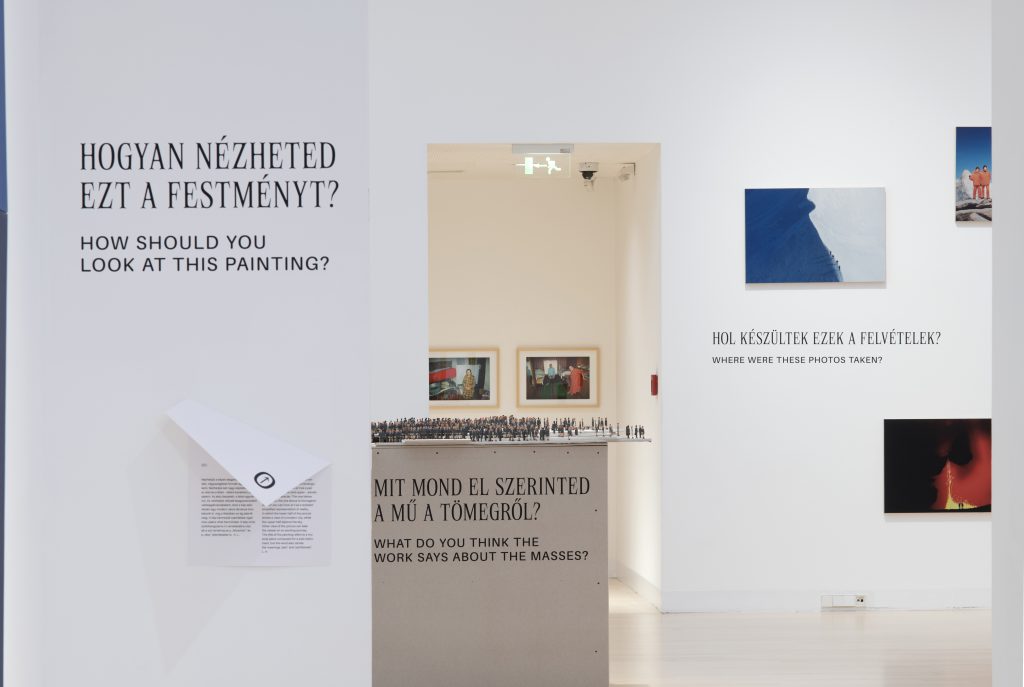
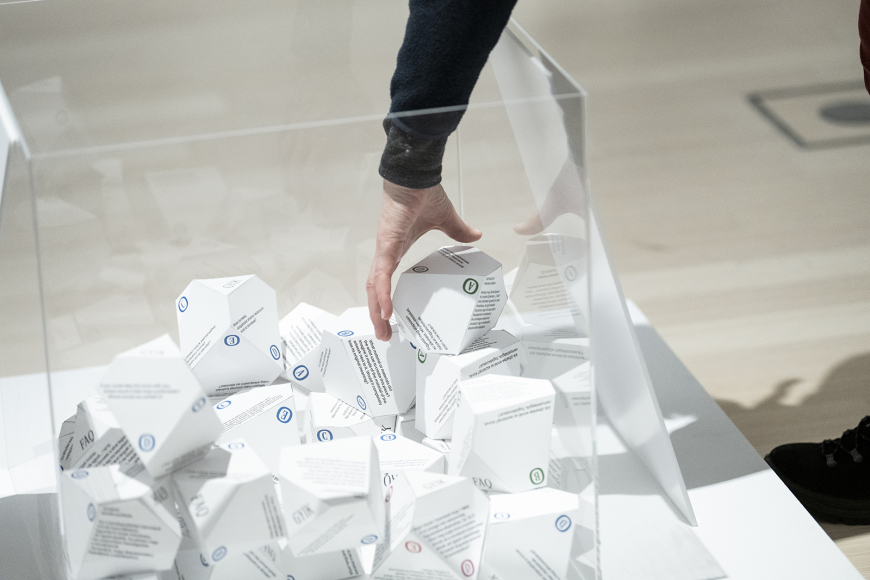
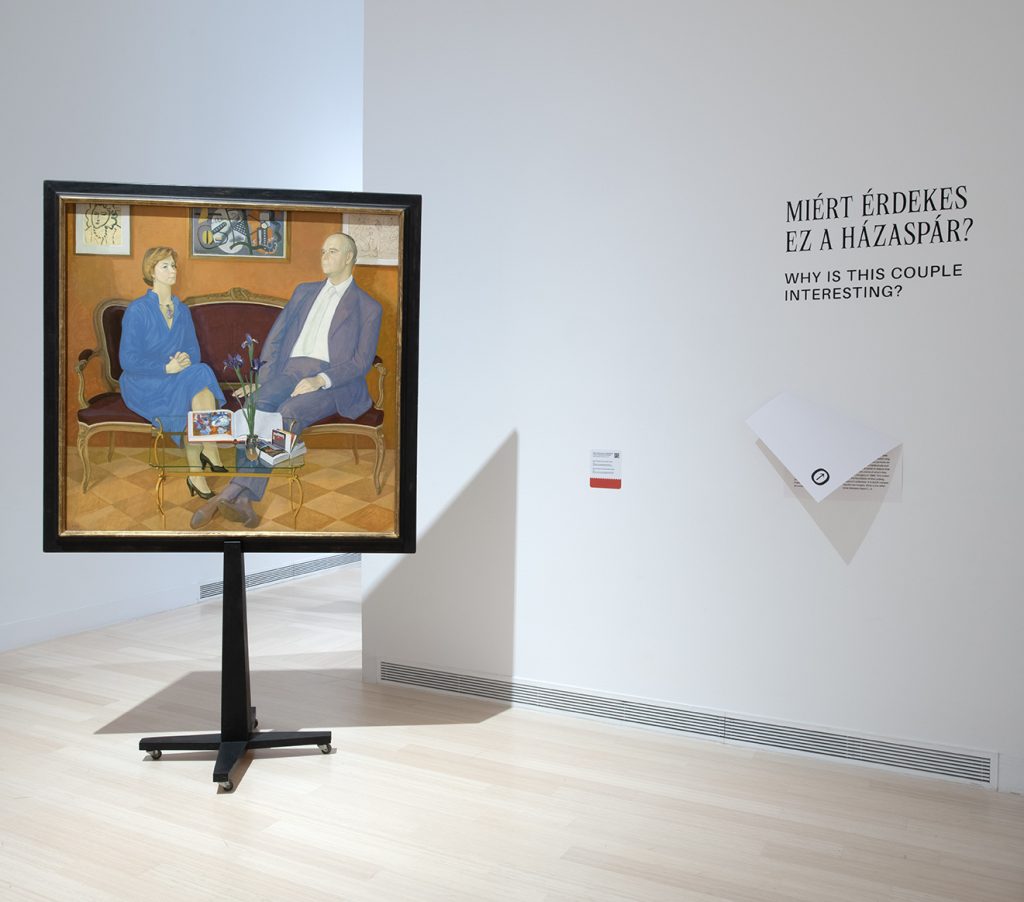
The exhibition guides visitors through a selection of works with a compilation of the sometimes imagined, sometimes observed questions of the “the general public,” as arranged by museum educators. Half-covered wall texts await visitors, inviting them to interpret the art without even reading the text. Despite the timing and good intentions of Frequently Asked Questions, however, Graham Harman’s object-oriented ontology (OOO) falls into two traps that are often repeated in philosophy.[12] While the interactive wall texts do offer a few lines towards answering the “all-caps / capital” questions asked about each work, they do so mostly without presenting even minimal context. Even if contemporary artworks do not have a “fixed table of explanations,” they do have points of reference that are not (or cannot be) known to non-expert visitors. The answers, though deliberately open-ended, prove to be a case of Harman-style “undermining” in reducing an object to its material without exploring the possibilities for interpreting the work. Let us assume that these texts contain “equally accessible information,”[13] even though they – aside from being reductive in content – also fail to explain concepts such as reproduction, paraphrase, and the like. In fact, it seems idealistic to expect accessing the complete descriptions via QR codes. There are also examples of “overmining” in the form of novel tools and aids, consisting of folded question polyhedrons, which I never observed being used once during my visit. The non-Platonic bodies decorated with questions reveal the error of “overmining” – in this case, not in a phenomenological approach to the works, but in the assumption that all the essential information about a work is available at first glance, even without background knowledge.
When I observed a visitor on a guided tour, the only time they seemed to truly engage with the showcased material was when they attempted to grasp the artistic concepts falling on the screen in a motion-sensor-activated data visualization — unsuccessfully. Other than that, they walked through the thematic sections, at times without reading the wall texts, at other times without even glancing at the accompanying works. What they cannot have missed was the last section – either because they acted like the journalistfrom Index who believed this was part of FAQ,[14] or because they had visited the museum during the past five years. That is because the same exhibition spaces had held, until 5 January, part of the exhibition Time Machine, a selection from the collection, while they are now listed on the website as comprising an autonomous exhibition.[15] Then again, its source code tells us that the website for the exhibition, which opened at the same time as FAQ, on 14 February, was published on March 12. A Time Machine, indeed.[16]
As part of the Czech, Slovak, and Hungarian art education project entitled Do You Have an Artistic Vein, almost identical exhibitions were held in Prague and then in Bratislava in 2022. When it was the Ludwig Museum’s turn, it came up with its own selection. The accompanying booklet states that the majority of visitors approach contemporary art from the perspective of classic art,[17] so, when we see that previous exhibitions guided their visitors to contemporary art by also involving classic art,[18] we might think that those shows were more based on this recognition by Hungarian colleagues. In contrast, in the Hungarian incarnation of this exhibition, the only classic work consisted of an image of Dürer’s Melancholia displayed on the screen.[19]
The Ludwig Museum’s exhibition was not the only art education initiative in Hungary in recent years; one need only think of 30+, a project maintaining a critical edge, organised by a leading public contemporary art institution in Debrecen, MODEM a few years ago.[20] While internationally, the Brazilian and Palestinian Tree School, founded in 2014, captures the essence of education in the act of dialogue, calling to mind the first schools organised in the shade of trees still without teacher-student roles,[21] while FAQ, despite its significant discursive programs and thought-provoking questions, provides no opportunity for the offering of meaningful answers. Its forms are limited to the data visualisation game known as Kinect or a children’s play corner reminiscent of what we see in fast-food restaurants. Thus, we really do feel like students at the exhibition – if we think of the frontal educational setup known in Hungary, which does provoke thoughts but also prompts us to keep them to ourselves. Maybe it is only really worth asking questions when we are also curious about the answers.
The exhibition points beyond the framework of museum discourse. Even more pressing is the global phenomenon of critical education, which began gaining momentum after World War II.[22] The systemic interpretation of education, instead of setting human development (Bildung) as a goal,[23] prioritises success in the labour market and salary. Without denying the responsibility of domestic education policy, it must be admitted that the abolition of art history as a school subject, the elimination of humanities majors in higher education,[24] and the restructuring of public universities into foundations[25] are very much in line with the international climate. The new National Core Curriculum, for instance, has diluted the humanities with more marketable elements, despite their role in general education and critical thinking, as well as in developing a democratic worldview.[26] None of this should come as a surprise, given that Hungary did not even have a ministry of culture for a long time after 2010. Instead, the sphere of culture – alongside health, education, and sports – was placed under the purview of an “HR department,” as if these were merely leisure time activities of its “employees.”[27]
As early as the late 18th century, G.E. Lessing warned art critics against going beyond their role of justifiably pointing out “mistakes” to suggest other solutions they deemed correct.[28] Today, what contemporary art tends to elicit in people is less of the “I could have done better” attitude outlined by the German playwright, and more of a feeling of “I could have done that”. And, were we to be encountering contemporary art for the first time, the exhibition entitled Frequently Asked Questions would make us feel that, yes, indeed, we could have done that. And this would not be in a democratising misinterpretation of the statement, but misrepresenting contemporary art as a technically and contentually simple – but at least funny – “gag” when compared to the aesthetics and complexity of classic art. If institutions contribute to this process while professionals and experts keep decreasing in numbers, there is a danger that the seemingly doomed and obsolete institutional framework of Hungarian contemporary art (dissemination) will morph into a reality.

If we consider contemporary art and its mediation to be a matter of cardinal importance, I consider my own situation to be so inconsequential that I will break the two-century-old, tried and tested rule addressed to critics: I will make a proposal – or rather a call – not to the subjects of this criticism, but to the collective, including myself. According to Anton Vidokle, critical art practice can be maintained by rearranging artistic constructions and structures: as it has been done by thinking in terms of schools instead of biennials, in projects instead of institutions, and in active communities (public) instead of passively receptive audiences.[29] Important experiments and practices are realised in the face of the unfounded confidence of institutions and the misguided approaches that sometimes result from it. Without claiming to be exhaustive, examples in Hungary include the Independent Art Department run by Attila Menesi,[30] and, within that, the Context program;[31] the LÉGIÓ [LEGION] artist group, founded by Lőrinc Borsos, as well as their open drawing workshops;[32] the Space of Opportunity;[33] in Romania, the Minitremu camps organised by the Monotremu artist duo;[34] and so on. After all, the task is not that complicated – let’s go outside, find a shady tree, and start a conversation under it.
Translated by Zsófia Rudnay
Ferenc Domokos is a student of the Master of Contemporary Art Theory and Curatorial Studies at the Hungarian University of Fine Arts, currently a Gallery Assistant at Várfok Gallery, a team member of the Aluvial exhibition space in Cluj and of the B5 Studio Artist in Residence in Târgu Mureș. Previously, he worked as an assistant at the Zsófi Faur Gallery and the Quadro Gallery in Cluj-Napoca. He holds a Master’s degree in Arts Management with a specialization in Curating from the Budapest Metropolitan University, with a Master’s thesis on Sustainability in Central and Eastern European Contemporary Art. He is also active as a curator and critic. He curated and organised exhibitions both in Hungary and Romania and published interviews and art critiques in Prae.hu, Mezosfera, and Új Művészet.
Patrick Nicholas Tayler is a Budapest-based painter and art writer. He studied painting at the Hungarian University of Fine Arts and spent the summer semester of 2012 at the Akademie der Bildenden Künste in Munich. Between 2018 and 2022, he completed his DLA studies at the University of Pécs, focusing on critical and theoretical approaches to ultracontemporary figuration and painting. His recent writings span from broad thematic inquiries into contemporary art to close readings of individual works. Tayler is a senior lecturer at the Painting Department of the Hungarian University of Fine Arts, an editor and author at Új Művészet, and a lecturer at the Moholy-Nagy University of Art and Design. He is also active as a translator and proofreader in various cultural projects.
[1] Although animals have successfully been trained to respond to various stimuli, even apes are incapable of formulating explicit questions: Geoffrey Pullum, Geoffrey. “Speaking Bonobo.” Interview by Paul Raffaele. Smithsonian Magazine. November 2006. https://www.smithsonianmag.com/science-nature/speaking-bonobo-134931541/.
[2] The Hungarian National Bank established its art collection in the 2020s, making it one of the most controversial cultural actions of the decade.
[3] Beke, László. Műalkotások elemzése: a gimnázium I-III. osztálya számára [Analysing Works of Art: Textbook for Highschool Students Grades 9th-11th]. 10th ed. 1985. Reprint, Budapest: Nemzeti Tankönyvkiadó, 1996. The book by the late curator and art historian László Beke (1944–2022), a prominent supporter of the Neo-avantgarde, was used in nearly all Hungarian high schools for decades.
[4] Bennett, Tony. “The Exhibitionary Complex.” New Formations NUMBER 4 SPRING I 988. http://seymourpolat.in/rp/texts/Tony%20Bennett%20-%20The%20Exhibitionary%20Complex.pdf
[5] E. Hein, George. “The Constructivist Museum.” In Learning in the Museum. Routledge, 1998. https://doi.org/10.4324/9780203028322-14.
[6] Hooper-Greenhill, Eilean. “Exhibitions and Interpretation: Museum Pedagogy and Cultural Change.” In Museums and the Interpretation of Visual Culture. New York: Routledge, 2000.
[7] Manifesta. “Manifesta 6 Nicosia.” Accessed 26 April 2025. https://www.manifesta.org/editions/manifesta-6-nicosia/about.
[8] O’Neill, Paul, and Mick Wilson, eds. Curating and the Educational Turn. London, Amsterdam: Open Editions & de Appel, 2010.
[9] Ludwig Museum. “Gyakran Ismételt Kérdések (GYIK)” [Frequently Asked Questions]. Accessed 26 April 2025. https://www.ludwigmuseum.hu/en/exhibition/frequently-asked-questions-faq.
[10] International Council of Museums. “Museum Definition – International Council of Museums,” 5 June 2023. https://icom.museum/en/resources/standards-guidelines/museum-definition/.
[11] Mihăilescu, Mimi. “How Călin Georgescu’s TikTok Tactics Rewired Romanian Politics.” The Loop, 28 November 2024. https://theloop.ecpr.eu/how-calin-georgescus-tiktok-tactics-rewired-romanian-politics/.
[12] Harman, Graham. The Quadruple Object. John Hunt Publishing, 2011.
[13] Ludwig Museum. “Gyakran Ismételt Kérdések (GYIK)” [Frequently Asked Questions]. Accessed 26 April 2025. https://www.ludwigmuseum.hu/en/exhibition/frequently-asked-questions-faq.
[14] Gáll, Anna. “A világ nem fog megváltozni, de az emberek hozzáállása igen” [The World Won’t Change, but People’s Attitude Will] Index. 19 February 2025.
The cultural journalist understandably assumed that parts of the exhibition—artworks, mostly so-called highlights from the collection—located on the same floor and not separated from the exhibition FAQ, were part of it. In reality, a large portion of a previous exhibition, Time Machine (based on the Museum’s collection and on view from 2020 until January 5, 2025), remained in place. This section was initially presented as part of FAQ, but only later was it designated as a separate exhibition.
[15] Ludwig Museum. “Ez már (művészet)történet. Válogatás a Ludwig Múzeum gyűjteményének legismertebb műveiből,” [This Makes (Art) History: Selection from the Best-Known Pieces of the Ludwig Museum’s Collection]. 12 March 2025. Accessed 26 April 2025. https://www.ludwigmuseum.hu/kiallitas/ez-mar-muveszettortenet-valogatas-ludwig-muzeum-gyujtemenyenek-legismertebb-muveibol.
[16] Ibid.
[17] Bence, Bettina, Barbara Nagy, and László Hemrik. GYAKRAN ISMÉTELT KÉRDÉSEK (GYIK): módszertani kiállítás a Ludwig Múzeum gyűjteményéből a kortárs művészet befogadásának megkönnyítéséért [FREQUENTLY ASKED QUESTIONS: Methodological Exhibition from the Ludwig Museum’s Collection to Facilitate the Reception of Contemporary Art], ed. Krisztina Dékei, transl. Dániel Sipos. Budapest: Ludwig Múzeum – Kortárs Művészeti Múzeum [Ludwig Museum – Museum of Contemporary Art], 2025.
[18] Freitagová, Martina and Ondřej Horák. Prečo umenie? Bratislava: Slovenská národná galéria, 2021.
[19] Despite the fact that one of the original editions of the artwork is owned by the Museum of Fine Arts, located exactly 6 kilometres away (6.7 km, if it is stored in the National Museum Conservation and Storage Centre [OMRRK], as it is not currently on display). Szépművészeti Múzeum [Museum of Fine Arts]. “Melankólia I. – Szépművészeti Múzeum” [Melancholy I – Museum of Fine Arts]. Accessed 26 April 2025. https://www.szepmuveszeti.hu/mutargyak/14602/.
[20] MODEM. “MODEM: 30+.” Modemart, 24 July 2023. Accessed 26 April 2025. https://modemart.hu/kiallitas/30/.
[21] Ludovici, Ginevra. “Exhibition as School, School as Exhibition.” PARSE Journal Autumn 2021, no. 13.3 (2021). https://doi.org/10.70733/3edvvghu756e.
[22] Its suppression began with the student revolts of 1968 because of risks recognized by politicians, and has been aided by the neoliberal, unrestrained market-driven approach that began emerging in the 1980s. K. Horváth, Zsolt (2024). “A kreativitás termelése. Esztétikai nevelés és az érzéki pedagógiai fejlesztése” [The Production of Creativity: Aesthetic Education and the Development of Sensory Pedagogy]: Ferenc Mérei. In Szívképzés [Heart Training] (p. 122). Budapest: Budapesti Metropolitan Egyetem [Budapest Metropolitan Museum].
[23] Zsolt, K. Horváth. “Sorban tűnnek el a humán szakok a felsőoktatásból, és ez nemcsak az egyetem eszméjének okoz kárt, hanem a demokráciának is” [Humanities Subjects Are Disappearing from Higher Education One After Another, and This Is Damaging Not Only to the Idea of the University, but Also to Democracy]. Interview by Ágnes Kende. Qubit, 8 January 2025. https://qubit.hu/2025/01/08/sorban-tunnek-el-a-human-szakok-a-felsooktatasbol-es-ez-nemcsak-az-egyetem-eszmejenek-okoz-kart-hanem-a-demokracianak-is.
[24] Gulyás, Adrienn. “Ez sem éri meg: megszűnő képzések a Károli Gáspár Református Egyetemen” [This Isn’t Worth It Either: Courses Being Discontinued at Károli Gáspár University of the Reformed Church] Mérce, 2 January 2025. https://merce.hu/2025/01/02/ez-sem-eri-meg-megszuno-kepzesek-a-karoli-gaspar-reformatus-egyetemen/.
[25] Böszörményi-Nagy, Gergely. “Mire jó az egyetemi modellváltás?” [The Point of Changing the University Model] Mandiner, 28 June 2022. https://mandiner.hu/velemeny/2022/06/mire-jo-az-egyetemi-modellvaltas-1.
[26] Tatai, Erzsébet. “Miért fáj nekünk a NAT? A vizuális kultúra, a művészetek és a Nemzeti Alaptanterv 2020-ban” [Visual Culture, the Arts, and the National Core Curriculum in 2020]. A Mű, 22 February 2022. https://amu.hvg.hu/2022/02/22/miert-faj-nekunk-a-nat-a-vizualis-kultura-a-muveszetek-es-a-nemzeti-alaptanterv-2020-ban/; Szalóki, Viktor. “Legyen újra önálló tantárgy a művészettörténet” [Let Art History Be a Separate Subject Again]. SzabadaHang. Accessed 26 April 2025. https://szabad.ahang.hu/petitions/legyen-ujra-onallo-tantargy-a-muveszettortenet; Oktatási Hivatal [Educational Authority]. “Vizuális kultúra: Felső tagozat – alap óraszám” [Visual Culture: Upper Grades of Elementary School – Mandatory Number of Teaching Hours]. Oktatási Hivatal [Educational Authority]. Accessed 27 April 2025. https://www.oktatas.hu/pub_bin/dload/kozoktatas/kerettanterv/Vizualis_kultura_F.docx
[27] From 2010 to 2022, the Hungarian government assigned culture to the Ministry of National Resources, then to the Ministry of Human Resources. This is the third year that the country has had a Ministry of Culture (and Innovation), headed by a businessman who served on the boards of some of Hungary’s largest companies; currently a pharmacist decides on the awarding of the Munkácsy Prize.
Vágvölgyi, Gergely. “Az Üzlettől a Nagykövetségen Át a Miniszteri Posztig – Kicsoda Csák János?” [From Business to Embassy and to Ministerial Post – Who Is János Csák?], 14 May 2022. https://mandiner.hu/belfold/2022/05/az-uzlettol-a-nagykovetsegen-at-a-miniszteri-posztig-kicsoda-csak-janos.
Spirk, József. “Hankó Miniszter Apja Által Felügyelt Kiadó Patronálta Évek Óta a Munkácsy-díjjal Kitüntetett Giccsfestőt” [Publishing House Supervised by Minister Hankó’s Father Has Been a Patron of Munkácsy Prize-Winning Kitsch Painter for Years]. 24.hu, 28 March 2025. https://24.hu/belfold/2025/03/28/hanko-balazs-munkacsy-dij-giccsfesto-gyogyszereszeti-kamara-galenus/.
[28] Lessing, Gotthold Ephraim, “A recenzensnek nem kell jobban értenie ahhoz, amit bírál” [Reviewers Need Not Be the Greater Experts on What They Are Judging], in Gotthold Ephraim Lessing Válogatott Esztétikai Írásai [Selected Essays on Aesthetics by Gotthold Ephraim Lessing], ed. Balázs István (1767; repr., Budapest: Gondolat, 1982).
[29] Vidokle, Anton. “From Exhibition to School: Notes from Unitednationsplaza.” In Art School (Propositions for the 21st Century), ed. Steven Henry Madoff. MIT Press Books, 2009. http://miguelpachecogomes.weebly.com/uploads/2/9/1/4/2914916/art_school_propositions_for_the_21st_century_-_massachusetts_institute_of_technology.pdf.
[30] Menesi, Attila. “Független Képzőművészeti Tanszék / F***K” [Independent Art Department]. Accessed 26 April 2025. https://fuggetlenkepzomuveszetitanszek.blogspot.com/.
[31] Mészáros, Luca. “Kéred a jegyzetem? – Kontextus Program #1” [Do You Want My Notes? – Context Program #1]. Képző.Art, 2 October 2024. https://kepzo.art/kered-a-jegyzetem-kontextus-program-1-2024-10-02/.
[32] Cserna, Endre. “MAgYArOrSzÁgOn nInCS HalLOweeN, Magyarországon Borsos Lőrinc Van (Blaek Eszkatológia). [In Hungary, There Is No Halloween, In Hungary There Is Lőrinc Borsos (Blaek Eschatology)]. Artmagazin, 16 January 2024. https://www.artmagazin.hu/articles/archivum/magyarorszagon_nincs_halloween_magyarorszagon_borsos_lorinc_van_blaek_eszkatologia.
[33] tranzit.hu. “Lehetőségek Tere” [Space of Possibilities]. Accessed 26 April 2025. https://lehetosegektere.hu/.
[34] Monotremu. “Minitremu.” Accessed 26 April 2025. https://minitremu.ro/.