Mentored by Vanda Sárai
Can a system whose raw materials and operations are based on exploitation be ethical? Who is responsible when the consequences of every human decision extend beyond those who make them? While these questions are rarely posed in tandem, the exhibition entitled Uprooting – curated by Mátyás Horváth and held at the Budapest Gallery – explores just such connections. The most striking feature of the exhibition is that it does not simply juxtapose related themes, but organizes a directed train of thought in three-dimensional space. Visitors move through the exhibition rooms as if they were following a slowly unfolding process; an arc gradually emerges, leading from the watering cans of petroculture to ecological alternatives that can be grasped on a human scale. Thus, in addition to critically examining the extractive logic of global agricultural chains, the exhibition also seeks to convey its effects in global and local contexts. In its approaching of the body, the earth, ecological knowledge, and the possibilities of resistance, the exhibition successively reveals the components of a production system that both uses and shapes nature, food, and the human body today.
For me, the strength of the show lies precisely in this gradual approach, rather than presenting isolated crisis stories, it presents the agricultural system maintained by a fossil fuel-based capitalism – i.e. petrocapitalism – as a spatially and thematically coherent whole. The exhibition makes all this accessible to visitors by remaining visually, contextually, and conceptually comprehensible, even to those who are unfamiliar with the subject.
This organizing principle is reflected in two of the exhibited works, which mirror the transition not only in their respective themes but also in their structural composition: the installation entitled Fertile Land (2023) by the Fuzzy Earth Collective and Cold Route (2023), and a joint video work by Pol Esteve Castelló and Gerard Ortin Castellví. Fertile Land’s conveyor belt-like row of textiles goes beyond merely following the journey of a raw material – phosphorus – from the mines of the Sahara to the shores of Lake Balaton; it also highlights how the invisible infrastructure of the global economy is intertwined with ecological damage manifesting at local levels. After scenes of mechanized mining and the transport of phosphorus by ship, the next textile-image jumps to the microscopic perspective, showing the consequences of excessive fertilizer use: nutrient- and oxygen-depleted waters and the proliferation of algae. This illustrates how the logic of global trade, based on cheap raw materials and profit maximization, has a direct impact on local ecosystems, implicitly raising other questions explored by the exhibition, such as what it means to move materials, energy, and knowledge; who controls their flow, and who bears the consequences?

Cold Route also carries this duality, this tension between the macro and the micro levels. This video work by Castelló and Ortin Castellví exposes the illusion of freshness, revealing links between the aestheticizing compulsion and distribution mechanisms of the market. While Fuzzy Earth’s installation traces the path of phosphorus, Cold Route follows the movement of the finished product – often vitamin-deficient, unripe fruit – as it transforms into promotional imagery and a means of representing capital. The images of sterile warehouses and refrigerated trucks seen in the video reveal that the freshness of imported fruit is not a natural state, but in fact the result of industrial simulation. The sight of apples and pears swirling in water goes beyond conveying a message, it also produces an illusion of freshness, naturalness, and well-being – everything that obscures the global logistics of their journey and the reality of exploited labor. These cold chain journeys ultimately alienate consumers from both the place and the time of food production, as well as the effort involved.

This problem is reflected on at another level, also in a video format, by Dániel Máté’s installation Indebted to the Earth, 2025, which approaches the issue from the perspective of the body, narrating the energy inequalities of industrial food production through the burning of a can of food, as a kind of guided meditation. Aside from the fact that it is always a pleasure to encounter well-made contemporary Hungarian video works – and Dániel Máté’s film is no exception – the installation offers an intricately nuanced picture of the interconnectedness between fossil-based agriculture and the physical reality of the human body itself becoming part of the energy flow. Here, the body is no longer seen as a metaphor for nature, but as the subject and object of the work process, since the bodies of those performing energy-intensive agricultural tasks are sustained (in the form of food) by the same petroleum that powers the machines they operate. The parallel between the exploitation of the earth and the depletion of human resources thus becomes increasingly powerful.
But who can be held responsible for the processes depicted here, and who is in a position to keep them in check? The exhibition does not shift the problem onto the consumer, nor does it eliminate individual responsibility from the equation; rather, it shows that the complexity of socio-economic relationships does not allow for simplistic answers. Most of the works question the ecological functioning of capitalism, especially its subordination of natural resources – be it soil, water, human labor, or time – to the desire for profit. This perspective, in part, brings us closer to Jason W. Moore’s[1] insights on food sovereignty. Capitalism is not simply an economic model, but a global ecological structure that operates nature, society, and capital accumulation as an organic whole. This unity has now begun to disintegrate, however, as the promise of cheap natural resources – which for centuries was a fundamental condition for the functioning of the global economy – now carries with it ever-increasing social and ecological costs.
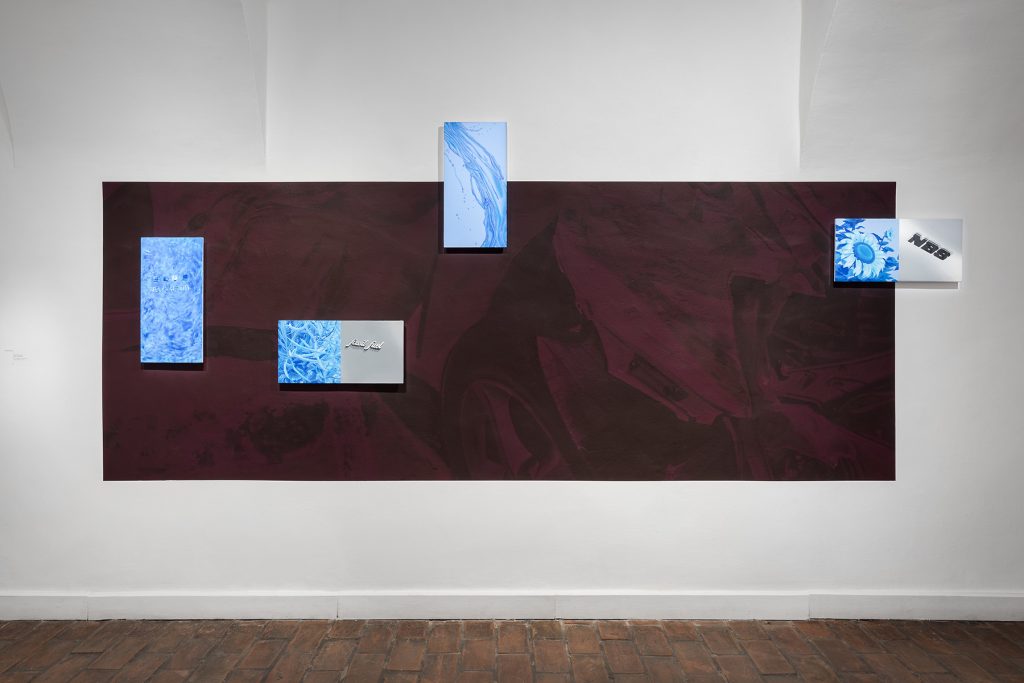
This approach is also visually expressed at several points in the exhibition. Rita Süveges’s series of paintings entitled Blue Revolution (2025) reinforces the critical position of the Capitalocene, attempting not only to overwrite visual language that promotes biofuels, but also to dismantle PR aesthetics and green rhetoric. Works previously existing in their elements[2] are now supplemented with site-specific murals, creating a new piece – a contemporary fresco-like work. Enlarged details of sunflowers and rapeseed appear simultaneously as food and alternative fuel, and written signs reminiscent of the logos of Nature-Based Solutions (NBS) also appear in their environment. The visual world of the fresco – clean, sterile, blue – evokes the aesthetics of sustainability, while at the same time also questioning it. Blue Revolution showcases the communication tools of green capitalism, while the term itself functions as an ironic rebranding, casting doubt on the sincerity and long-term impact of green revolutions. The motif of the car crash visible in the background also undermines the credibility of the green vision; we have no way of knowing what caused the collision, but its consequences are clearly visible. What does sustainability really mean if the logic of technology and economic mechanisms remains unchanged?
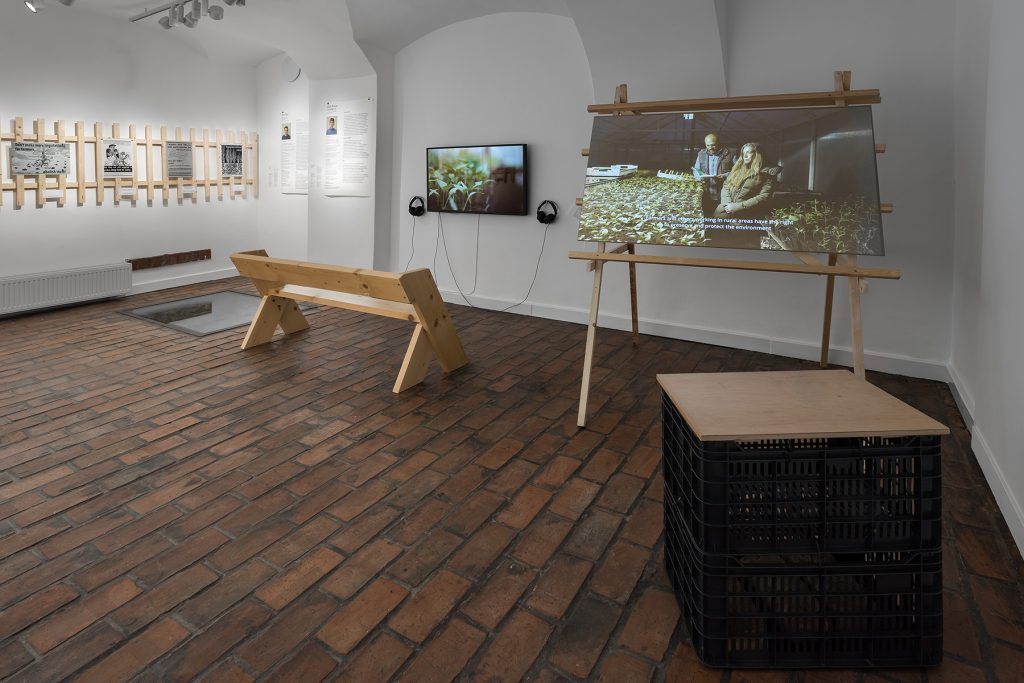
In the room which signifies the endpoint of the exhibition, the emphasis shifts: after stories of production and exploitation, the focus finally falls on rethinking our relationship to the earth. In the project entitled The Spectre of Peasantry (2024), Tomáš Uhnák and Asia Dér, as well as Tamás Kaszás and Asunción Molinos Gordo, no longer merely offer criticism, but also propose alternatives. Based on the principles of the La Via Campesina movement,[3] the installation asks smallholders, farmers, and peasants what land, production and autonomy mean to them, thus thematising not only the marginalization of agrarian life but also the ways in which this position can become a form of resistance. In documentary excerpts, Czech farmers read from the United Nations Declaration on the Rights of Peasants, while sharing their own experiences of their relationship to work and to the land. This brings to the surface the problematic of legal and economic vulnerability, as well as identity politics surrounding language (peasant–landowner–farmer). The installational components of the space – posters, fencing, peasant autobiographies (one of the video installations stands on a slatted structure reminiscent of hay dryers) – as illustrative elements, signify attempts at constructing an alternative language and representation of the rural communities. Peasantry as a role is more than merely a historical memory; it can be reinterpreted – and, in fact, is worth rethinking – in the context of the current conditions of production. When looking at the exhibition as a whole, it was the participatory and human-centred focus shown here that, in its anthropological aspect, meant the most to me.

Finally, it is worth mentioning that the exhibition was created as a master’s thesis[4] project – not only because of the depth and complexity of the material, but also because it clearly succeeded in establishing a position that is both conceptual in its thought formulation and sensitive to everyday experiences. These are the kind of experiences that we truly feel in our own skin, whether it be physical exhaustion, the unpredictability of the weather, the constant rise in food prices or the absurd normality of having access to fresh tomatoes all year round.
Translated by Zsófia Rudnay
Gyöngyvirág Agócs graduated in 2024 from the Moholy-Nagy University of Art and Design
with an MA in Design Theory, specializing in curatorial studies. She is currently participating
in a research fellowship program, working on curatorial projects, and completing her degree
in a Design and Visual Arts Education program at MOME. She has previously contributed to
exhibitions such as Unknown IPARTERV (Hungarian Museum of Architecture, 2022) and
What Year Are You? (2024), the public collection exhibition of MODEM. From 2025, she
has been a member of The Studio of Young Artists’ Association. Her main interest is to better
understand the collectively lived experiences and structures of the recent past in an East-
Central European context, aiming to help visitors perceive that problems lived individually
can be equally systemic.
Vanda Sárai is a Budapest-based independent curator, art writer and researcher. She
completed her studies in Budapest and Jena, and is currently working on her PhD at Eötvös
Loránd University, focusing on the effects of attention economy and digital culture on
contemporary art and its institutional system. She is a guest lecturer at the Art and Design
Department of Metropolitan University Budapest. She was a member of the curatorial
collective, Teleport Gallery (2016-2018). As a curator, she won the Esterházy Art Dating
Prize and the MODEM Prize for Young Curators. Between 2017 – 2021, she worked in the
editorial team of Műértő. In 2022 – 2023, she was the gallery manager of the non-profit art
space 1111. She participated at several residency programs, most recently she was a curator-
in-residence at MQ Wien. Her most notable shows were: Time of Our Lives (co-curator), Afraid I Can Do That (2023); Kádár Emese: NOT_FOUND (2024); delulu is not the solulu (2025).
[1] Jason W. Moore: “Cheap Food and Bad Climate: From Surplus Value to Negative Value in the Capitalist World-Ecology.” https://jasonwmoore.com/wp-content/uploads/2017/08/Moore-Cheap-Food-and-Bad-Climate-2015-CHS.pdf
[2] Although most of the works have been previously available for viewing (including some in the Budapest Gallery’s other projects), they now operate differently as a result of the exhibition concept, the rearrangement of the work and certain elements, and the reinterpretation of the relationships between them.
[3] La Via Campesina, founded in 1993, is an international movement defending agriculture for food sovereignty.
[4] Organizing an exhibition is part of the MA graduation requirements for students of the Curatorial Program at the Hungarian University of Fine Arts. This show was curated as such a project.


