Mentored by Dorota Jarecka, Katarzyna Kołodziej-Podsiadło and Karolina Plinta
Since Zachęta – National Gallery of Art in Warsaw was wrested from the controversial directorship of Janusz Janowski, this was the first time the general public had been invited to such a comprehensive exhibition.[1] Unlike the earlier From the Ashes, Tears of Joy was an exhibition that filled almost the entire gallery. The space was filled with a wide variety of works, ranging from monumental to intimate pieces, both new and bearing the name of the contemporary canon. The enduring influence of the classics and their proximity to contemporary works was clearly visible. While they did not always enter into direct dialogue, a perceptible continuity was evident, made possible by Zachęta’s decades of existence. As both a stand-alone exhibition and a display of the extensive collection, the selection of works was impressive. However, the curatorial narrative – or perhaps the institutional PR storytelling – surrounding Tears of Joy suggested that it was not merely a retrospective, but rather a project designed to establish a new identity in opposition to the ‘dark’ years under Janowski’s leadership.
One obvious sign of change was the shift in thematic scope towards works that engage with social issues and take the side of minorities. The means of expression also changed, with performance taking the central place, previously occupied by painting, which was crucial to the conservative directorship. At Tears of Joy, performance took centre stage, particularly in works by artists such as Paweł Żukowski, Nadia Markiewicz, Daniel Kotowski and Teatr21, which date no further back than five years ago and engaged in dialogue with iconic pieces from Zachęta’s collection. Edka Jarząb’s composition was the only piece that seemingly did not fit into this scheme, as it was not really a performance. However, as a sound composition, it also contributed to the break with object-based art.[2] To understand this shift, though, one must look beyond technical matters and art-historical taxonomies. The turn to performance resonated with Zachęta’s interest in embodied practices that foreground a sensual understanding of aesthetics, while transcending the logic of artistic labour as working towards a closed work-product. This was the logic that seemed to permeate Janowski’s Zachęta, with its rooms occupied by paintings hung according to colour.

The institution’s transformation was also evident in the curators’ attitude towards visitors. In conceptualising the ‘embodied’ parcours through Tears of Joy, they did their homework not only on museum fatigue, but also on the shifting focus from visual to multisensory engagement – two key themes in contemporary art discourse. Even if the invitation to an enhanced, embodied experience was not widely embraced by the institution’s visitors – or, at least, this is how it appeared to me – the guests undoubtedly benefited from the opportunity to engage with the works at a slower pace, whether that be by lying down, sitting, resting or relaxing.
With the focus on performance, corporeality, unconventional forms of expression, social sensibility and critical art, it was hard not to feel that the exhibition was intended as a proclamation. Tears of Joy functioned as an explicit antithesis of the previous management’s programming. At the same time, the narrative surrounding the exhibition looked towards the future, posing the important yet tentative question: shouldn’t other periods in the gallery’s history be revisited besides the recent conservative years, and can something new be built upon their foundations? The effect is akin to a dramatic ‘Check!’
While examining the prospects before the ‘liberated’ Zachęta, Tears of Joy presented an evaluation of the heritage of engaged Polish art from the turn of the last century. This was no coincidence, as the complicated history of Polish Critical Art – which is as influential now as it was shocking back in the day – ran parallel to that of the National Art Gallery. From today’s perspective, showcasing key examples of this art emphasised the institution’s pivotal role in shaping the contemporary canon of Polish art history. However, in doing so, Tears of Joy failed to maintain Zachęta’s reputation as a provocative gallery, instead shaping it into a more traditional museum. After all, what was shocking over twenty years ago was now set to restore ‘normality’. Heaping references to the past that sanction Zachęta’s central role in recent Polish art history, the show closed on itself in a vicious circle of self-referentiality. At the same time, the curatorial narrative really forced itself upon the works shown in Tears of Joy, while its forward-looking promise simply could not withstand the clash with the historic works on display. In the vicinity of Kozyra or Dawicki’s ‘classics’, the novel performative works appeared ephemeral and self-conscious, which made them unable to resonate with comparable force. The past loomed large, and the idea of using a survey of the collection as a starting point for the future was not persuasive at all.
For all its flaws, it is fair to say that the curators’ narrative did not detract from the exhibition’s greatest strength: the most recognisable works on display once again proved their decisiveness, clarity and charm. However, it was probably for this reason that Zachęta completely capitulated to Katarzyna Kozyra, thus reinstating the cult of the great artist™. Two rooms were devoted entirely to her works, Rite of Spring and Summer Tale, and even in the more polyphonic opening part of the show, her presence felt overwhelming despite strong competition from Artur Żmijewski and Zbigniew Libera.[3] This kind of excess was bound to leave a strong aftertaste, particularly in the context of Zachęta’s declarations about community building – a value and practice that proves difficult to achieve, regardless of its political pedigree.
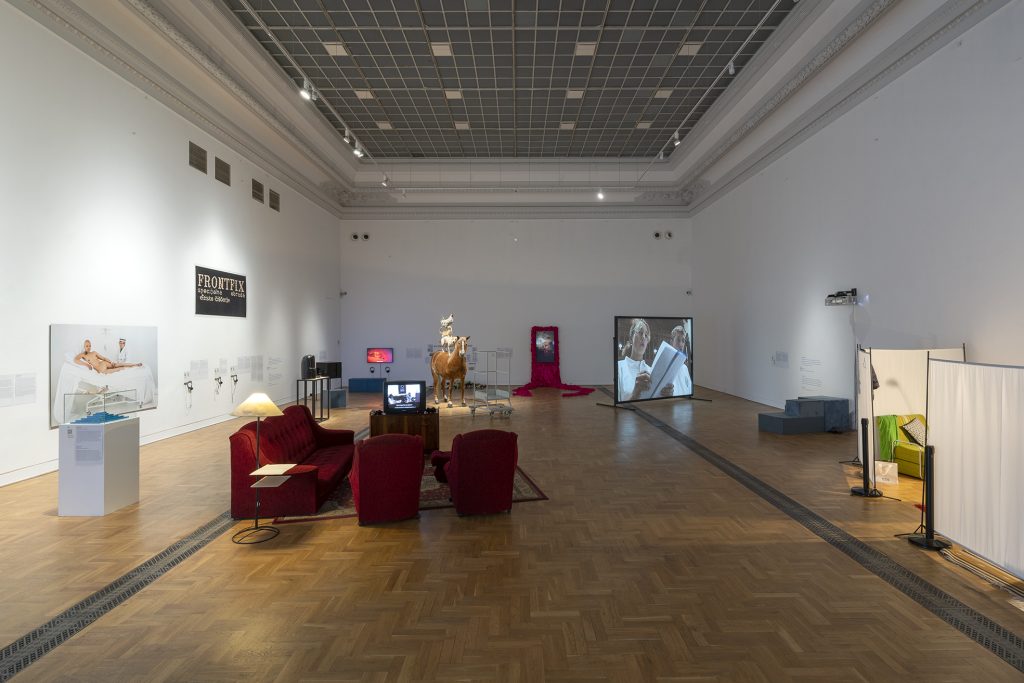
It is curious that the examples of Polish critical art presented in the exhibition – and the feminist-leaning ones in particular – still hold that much power. Is this due to its universal and timeless relevance? Or is it the result of the wider – and rather terrifying – context in they have functioned, whether twenty or thirty years ago or today? Sadly, the concerns of the turn of the 20th and 21st centuries continue to feel very much valid: women’s rights are still being used as a political tool, the occupation of Palestine continues unabated, and the fight for animal rights has stalled. As if this were not enough, the letters of Mariola Przyjemska’s Frontfix (1996), a work that looms over one of the exhibition rooms, have come to remind of the logotype of the EU’s border protection agency Frontex (established in 2004). A critical concern and the feeling for socially-minded works in Zachęta’s collection are aroused by the time in which the gallery has to function: it does call for a critical art. At the same time, against the backdrop of ongoing crises, all art seems ineffective and weak.
The latter, defeatist sentiment feels particularly close to me when confronting canonical forms of art, which have long ceased to be the voice of the young, angry and ambitious, shouting from someplace on the peripheries. When the young have to compete for attention with the older and more established, the feeling becomes all the more perceptible. A critical question must therefore be asked: for whom is there still no place in the centre – or, to be more specific, this centre: Zachęta – nowadays? In Tears of Joy, certain oversights did catch my attention. For instance, intersectional and queer perspectives on art and society were underrepresented, despite the strong presence of anti-patriarchal feminist, lesbian and gay propositions, whose identitarian positionality reflected the strategies of most non-heteronormative art in Poland until recently. The loud debate on the precarious conditions of artistic labour and the class dimension of works also remained shrouded in suggestive silence.
Despite the shock value of some of the pieces in Zachęta’s collection, the exhibition’s calm yet creative display had a meditative effect. It culminated in the section that featured Oskar Dawicki’s Tears of Joy – a video from which the whole project took its name. The work was a fitting centrepiece for the exhibition, hinting at the paradox that permeated the project. Crying is a state that occurs in extreme situations, including those that make one particularly sensitive to inequality, injustice, and pain – hallmark themes of Polish critical art. Meanwhile, as joy is an undeniably positive and uplifting affect, it can also lead to unusual and extreme reactions. It is of note that the eponymous tears in Dawicki’s work are so blatantly unreal: they defy gravity. They literally lift upwards, and they are visibly paid for with maximum effort, leaving no room for interaction beyond an exchange of a deep look with a passer-by. These tears represent sacrifice, effort and labour. They are not really tears of joy because, as carla bergman and Nick Montgomery rightly point out, joy has a subversive charge and the power to enliven that the treacherous promise of happiness lacks.[4] Perhaps this is the promise that the tears pointed towards at Zachęta – there was no subversion here, only reactionary canonisation.

Translated by Arkadiusz Półtorak
Jakub Wydra is a doctoral student at the Jagiellonian University Doctoral School of Humanities in the interdisciplinary program Society of the Future and a graduate of Interfaculty Studies in the Humanities and Cultural Management. He works as an art critic, journalist, and social researcher of cities in the Anthropocene. His academic interests lie in the intersection of social sciences and posthumanism, and the use of sociology in the study of the art world and contemporary visual arts.
His mentors were:
Dorota Jarecka is a Polish art historian, critic and curator whose work focuses on modern and contemporary art, visual culture and the social history of art. She is affiliated with the Institute of Literary Research at the Polish Academy of Sciences (Instytut Badań Literackich PAN) and has published widely on topics ranging from Surrealism and the neo-avant-garde to documentary and curatorial practice. From 2016 until 2024 Jarecka served as director of Galeria Studio in Warsaw. Earlier in her career Jarecka worked as a journalist and critic (including a long spell at Gazeta Wyborcza), organised programs and workshops at institutions such as the Museum of Modern Art in Warsaw, and collaborated on curatorial and editorial projects. She is the co-author/co-editor of books and catalogues, notably the monograph on Erna Rosenstein (Erna Rosenstein. Mogę powtarzać tylko nieświadomie) and publications on post-war and contemporary Polish art. In recognition of her contributions to art criticism, Jarecka was a recipient of the Jerzy Stajuda Prize for Art Criticis in 2011.
Katarzyna Kołodziej-Podsiadło is an art historian, curator at the Zachęta – National Gallery of Art in Warsaw where she curated or co-curated among others The Potential Histories
(2024/2025); The Tears of Joy (2024); Two arts are better than one (2021); Rechowicz/Smaga. Cirle (2019); Money to burn (2016); Victor Man. Zephir (2014); THE ARTISTS. Visual artists’ concerts and sounds projects (2013-2016); Hools (2012). Her curatorial approach is characterised by attention to how exhibitions can function not only as displays of artworks but as devices for generating new dialogues — often incorporating performance, sound, and participatory elements in the gallery space. Her projects have also provided critical takes on Polish and global art histories.
Karolina Plinta is an art critic, editor-in-chief of the magazine “Szum” (together with Jakub Banasiak). Author of numerous texts on art, since 2020 host of the podcast “Godzina Szumu”. Winner of the Jerzy Stajuda Art Criticism Award (for the magazine “Szum”, together with Adam Mazur and Jakub Banasiak). Her writings have appeared in major Polish cultural publications and she has also contributed to educational initiatives focused on art careers and professionalization of artists. Her interests include performative arts, institutional critique (especially engaging with how art institutions work and fail), gender in art and feminist perspectives.
[1] Editor’s note: Janusz Janowski is a Polish painter, musician, and art theorist who has served as director of the Zachęta – National Gallery of Art in Warsaw in 2022-2023. His appointment, following a tenure as president of the Gdańsk branch of the Association of Polish Artists and Designers (ZPAP), has been met with considerable debate within the Polish art community due to his conservative cultural views and the political context of his nomination.
[2] Editor’s note: Edka Jarząb presented Zwykłe wycie (‘Ordinary Outing’), a sound composition performed together with invited participants. Through collective vocal gestures that moved between cry, chant, and noise, the artist explored the affective and spatial dimensions of sound within the gallery environment.
[3] Editor’s note: Katarzyna Kozyra, Artur Żmijewski, and Zbigniew Libera are among the most prominent figures associated with the so-called Polish Critical Art movement that emerged in the 1990s. Formed in response to the social transformations of post-communist Poland and supported by new institutions such as the Centre for Contemporary Art Ujazdowski Castle in Warsaw, this generation of artists explored themes of power, the body, religion, and social exclusion through provocative and politically engaged practices.
[4] See: carla bergman and Nick Montgomery, Joyful Militancy. Building Thriving Resistance in Toxic Times, AK Press 2017.


