Mentored by Katarína Rusnáková
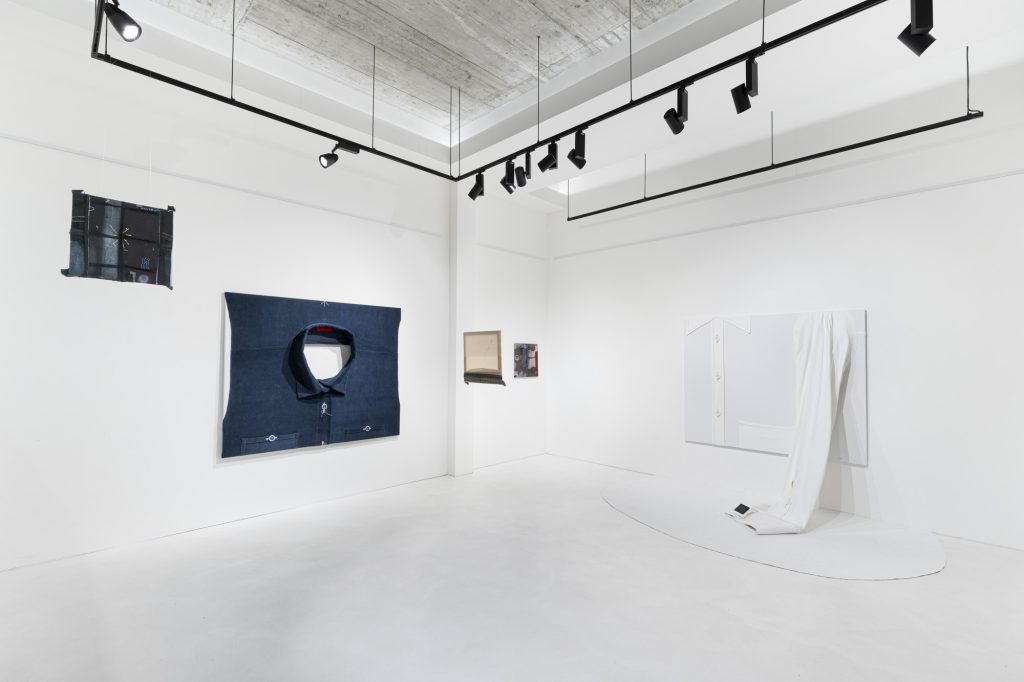
At the turn of October and November 2024, Station Gallery in Bratislava hosted an exhibition of the latest works by Emőke Vargová, entitled Nobody and Nothing, curated by Lucia G. Stach.[1]In the intimate setting of the gallery, conducive to a more personal reception of the works, the artist unfolded her material world stitched together with fabric and clothing. Through her textile paintings, she addresses the empty places left behind after somebody or something. Although the works are rooted in her personal experience, viewers may discover intersections with their own lives. The personal thus becomes universal, intertwined with the empty places we all carry within ourselves.
At the exhibition, Emőke Vargová presented large-scale textile works in which fragments of formal men’s clothing acquire new meanings and generate visual narratives that unfold across both intimate and social dimensions. Smaller, more abstract compositions function as stage settings into which stories are embedded, operating as backdrops of tension, relationships, or memory. This principle can also be found in the work Universum (2024). Vargová deliberately works with appropriated garments, which she recontextualises and reworks in the spirit of assisted readymade. In these works, unconventional material contrasts with the traditional framing of painting, thereby transcending the realm of everyday life and acquiring the status of an artistic artefact. Her works may thus be considered sewn images balancing between painting and soft sculpture. Through stitching, the artist weaves memories of relationships into the fabric of her pictorial narratives, relationships that have left behind empty spaces. The textile medium enhances the haptic qualities of the works, which the viewer can also experience through touch. Just as particular scents may evoke memories of people and events, so too can contact with the smooth, rough, ribbed, crumpled, dirty, or embroidered textures of fabric activate memory traces. Touch thus deepens the experience of the artwork while simultaneously reviving the sense of absence of the missing body.
Since the 1990s, Vargová has been inclined to work with diverse materials, subjecting them to experimentation, testing their limits and seeking ways of exceeding them. In her current pictorial cycles, she sews her works made of a variety of textiles, favouring old garments and altering their meaning through artistic transformation. The strategy of reuse or upcycling—repurposing materials with the added value of new meanings—has in recent decades become increasingly prevalent in contemporary art. It serves both as a critique of overproduction and as a reflection of the environmental crisis.
In this exhibition too, Vargová works with the method of upcycling old jackets and second-hand fabrics, a practice already familiar from her earlier projects Prime Line (2018) and Missing Line (2020). The work From Mother: “You Are What You Eat” (2024) was created from the uniform of the Presidential Honour Guard. The garments, having fulfilled their original function, are transformed into specimens of social relations—deconstructed and stretched onto a wooden frame. Displayed within the gallery, these works acquire the character of artefacts of the past, which, although still representing masculinity, authority, and dominance, appear as relics of the patriarchal system that should be consigned to the wardrobe. They stand as reminders of what no longer belongs to the present, yet still surrounds us, with the textile bearing traces of their original function and the values they once embodied. The material thus becomes an instrument of reflection on societal themes. In works such as Evolution, Old Man, and Nobody (2024), Vargová adopts a different approach. She created enlarged versions of formal men’s clothing, which naturally reflect social values and norms. By magnifying the dimensions of the garments, she indicates their elusiveness, alluding to the predominance of patriarchal structures that remain dominant and continue to shape society profoundly.
Although Emőke Vargová herself states that her works “do not arise from feminist motivations,” her oeuvre inevitably lends itself to feminist interpretation. Textile work—sewing, weaving, embroidery, crochet, or knitting—has long been socially coded as traditionally feminine, despite its historical practice by men as well. Over time, these activities became largely the domain of women and were labelled feminine. In the hierarchy of the arts, they have often been classified as crafts in opposition to fine art, and thus relegated to the margins of art history. Vargová’s textile paintings therefore necessarily continue a long line of often marginalized women artists who have engaged with the medium of textile as both a personal and political gesture of expression, subversively rejecting the patriarchal canon of art.
The potential of textile as a medium for disrupting established structures is also manifested in Vargová’s emphasis on detail. The structure of formal men’s attire is typically meticulously designed, with each element and detail conceived to produce a coherent appearance and harmony. This traditional ideal of elegance expresses not only authority and status but also evokes strong associations with conservative values. It contrasts with Vargová’s manner of presentation, which inverts its meanings and reveals its imperfections. Loose threads, traces of use, and sweat stains become commentaries on entrenched social structures. Vargová employs materials such as corduroy, checked textiles, and old uniforms, which connote tradition yet simultaneously obsolescence.
Individual pieces are supplemented with fictitious labels—EVOLUTION, NO*BODY—that ironically allude to actual clothing brands, yet invert their meaning, thereby reflecting the character of figures from memory. EVOLUTION thus becomes a commentary on obsolescence, assumed elegance, and emptiness, reflected in torn pockets filled with wealth devoid of real value. In the uniform of the Presidential Honour Guard, not only traditional but also nationalist values converge, further underscored by mother’s embroidered handkerchief bearing the cliché “You are what you eat.” Here, the personal intertwines with the political, opening questions of family ties as well as the intergenerational transmission of ideological and cultural values. Their stability is undermined by sweat stains, attesting to a nervous body struggling with expectations and succumbing to pressure. A uniform that once signified pride and protection has become a site of failure. Similarly, in the work Old Man, the father’s shirt—with its absent body behind the translucent fabric—extends its sleeve beyond the pictorial plane like a burdensome memory, embodied in the oversized cuff. The shirt thus represents a relic of its wearer, who continues to haunt, with the sleeve’s intrusion into the composition manifesting the persistence of paternal authority. By demasking the layers of clothing, Vargová unveils social norms, with the details in her textile paintings becoming traces that bear the scars of memory—personal as well as collective.

Another semantically rich work is the artwork called Fly (2024), which resembles a pictorial landscape assembled from layered shirt fragments and transparent textiles, on which a “fly” is rendered in thread. The motif of the fly has a long tradition in visual culture. It can be read within the context of imitation of nature (imitatio naturae), as a reminder of human mortality, decay, and the transience of all earthly things (memento mori and vanitas), or as an optical illusion (trompe-l’œil)—proof of an artist’s mastery and skill.
In Alpine Renaissance painting, we encounter oil portraits featuring flies depicted as if they had alighted by chance upon the canvas. At first glance, viewers may attempt to shoo the fly away, only to realise it is painted, and their surprise gives way to admiration of the painter’s virtuosity. The principle of trompe-l’œil also resurfaces in Marcel Duchamp’s work Torture-Morte (1959), an object consisting of a realistically painted plaster cast of a human foot covered with flies. Set into a reliquary-like case, the work’s title puns on the French nature morte (still life), replacing “nature” with “torture,” thus producing “torture of the dead.” Duchamp thereby ironically comments on the veneration of bodily relics of saints and martyrs in Christian tradition.
The cult of relics was not only an expression of piety but also carried ideological weight, with many relics obtained dubiously, blurring the boundary between reverence and exploitation of the dead body. The authenticity of such fragments is often questionable. Attracted by the stench of decay, the fly thus becomes not merely an illusory detail but, through the play on the title, a symbolic disruptor of established norms and religious practices. The fly is perceived as an intrusive, seemingly pointless creature that settles on food, leaves traces, and irritates us with its buzzing and tickling. We repeatedly attempt to drive it away, but it persistently returns until eliminated. In a similar way, the protruding threads present in the textile paintings disrupt the polished appearance of garments, becoming symptoms of disintegration of dominant social and symbolic orders.

The works of Emőke Vargová are imbued with ambivalent meanings, making them instruments of unease and disruption of everyday life, where we strive to eliminate all elements that disturb order. Vargová playfully transforms the materiality of textile into a bearer of meanings, encouraging shifts in perspective and critical reconsideration of structures. Through sewing, she initiates a long process of healing and reconciliation with empty places, stitching the scars of memory into the fabric of textile itself.
Translated by Kamila Talarovič
Dominika Lazorová is a master’s student of art history and theory at Trnava University in Trnava. During her studies, she completed a study stay at the Seminar of Art History at Masaryk University in Brno (2023). She is interested in the temporality of works of art, reflections on the memory of materials, and how fragments of the past speak in the present. She has published reviews in the journals Profil súčasného výtvarného umenia / Contemporary Art Magazine and World Literature Studies.
Katarína Rusnáková is a historian, theorist, and art critic. She studied fine arts at the Faculty of Philosophy of Comenius University in Bratislava (1983), where she completed a study stay at the Department of Aesthetics and Art Sciences (1983-1985). She completed her doctoral studies at Palacký University in Olomouc (2007-2009). She worked as an art historian in the Office of the Chief Architect of the City of Žilina (1985-1990), and since 1990 as curator and director of the Považská Art Gallery in Žilina (1992-1997), independent critic and curator, director of the Collection of Modern and Contemporary Art at the National Gallery in Prague (1999-2000), and researcher at the Institute of Art and Science at the Academy of Fine Arts in Bratislava (2003-2005). Since 2006, she has been head of the Department of Art Theory and History at the Faculty of Fine Arts at the Academy of Arts in Banská Bystrica. She researches world and Slovak visual art of the second half of the 20th century and the 21st century, especially video art, digital art, and gender issues.
[1] Emőke Vargová: Nobody and Nothing. Bratislava: Station Gallery, 17 October – 21 November 2024. Curator: Lucia G. Stach.