In the twenty-first century, in the Capitaloceneera, Lovecraftian weird epistemology is witnessing a renaissance, not only in popular culture, but also in philosophy and aesthetics.[1] The ancient, alien and seemingly irrational gods of Howard Philips Lovecraft’s world appear in streaming (TV)series such as True Detective, Stranger Things and Lovecraft Country, and inspire academic books such as Cyclonopedia, Dark Ecology and Weird Realism.[2] Lovecraft’s fiction, influenced by Nietzsche’s philosophy,[3] imagines us living in a vast and indifferent universe, the workings of which we have little idea. This universe, moreover, is ruled by beings that we are terrified to see, because we cannot even imagine their true extent and power. Lovecraftian weird science fiction became intertwined in the early twenty-first century with the new materialism of Deleuze and Guattari,[4] which attributes a specific intelligence to inorganic matter, and with the ontology of Bruno Latour,[5] which imposes the worldview of animism on Western culture and endows both things and objects with agency.
The theories and fictions of the most important new weird philosophies, speculative realism and new materialism, are also a strong concern for contemporary artists, as non-human perspectives beyond humanism and capitalism infuse fresh energy into the practice of image-making and object-making. New horizons, cosmological and ecological, are emerging, such as the “logic” of the autopoietic Gaia, according to which the Earth is a self-organizing, self-forming physical and cybernetic system, or the fiction of a sustainable, Chthulucene “humanism,”[6] which emphasizes empathy and mutual understanding of each other’s existence and situation, ranging from humans to spiders to fungi and bacteria, inspired not only by contemporary ecology but also by the existence of ancient, tentacular goddesses. The gods of the Greeks, the Maya, the Polynesians and Lovecraft – populating the fictive worlds of Hollywood, HBO, and Netflix – also evoke the spectacular sublime dimensions of the capitalist entertainment industry, which could be diverted (détournement) from its original purpose by the exponents of new materialism.[7] In the following, I will discuss three groups of Hungarian artists who, in this spirit, combine popular culture based on classical topoi, avant-garde artistic praxis and post-humanist and post-Anthropocene philosophical reflection.
XTRO REALM
Xtro Realm was founded in 2017 as a collaboration between Gideon Horváth, Rita Süveges and Anna Zilahi. Their name refers to Quentin Meillassoux and his philosophical fiction of “extro-science” (hors-science) worlds,[8] which are devoid of rationalism and causality, i.e. they are dominated by contingency and unpredictability. Such worlds appear in the science fiction of Isaac Asimov, Philip K. Dick, Douglas Adams and René Barjavel, but the problem of causality has also been a live concern in philosophy since the time of David Hume. Meillassoux’s philosophical point of departure is Kant, his critique of Hume and his so called “correlationalism,”[9] which can only describe reality in terms of the subject’s relation and correlation to reality. This epistemological critique of Kantian humanism has greatly inspired contemporary speculative realist philosophers who explore the logic and function of non-human beings and phenomena. The collection of texts edited by Xtro Realm, Extrodaesia,[10] expands on this perspective by replacing human land survey (geodaesia) with the horizon of extro-science, that is, by imagining a non-human geography through new horizons of the Post-Anthropocene. Horváth, Süveges and Zilahi, in addition to the fictions and theories of Extrodaesia, have presented a new posthuman image of the Earth in concrete reality, through Anthropocene field exercises, and have also compiled a “climate imagination” reader on global warming and criticism of the “humanist” Capitalocene, in which Süveges analyzed the pictorial constructions of the sublime landscape.[11]

Süveges has also dedicated a solo exhibition[12] (fig. 1) to the fantastic, red, sublime landscape of Gánt, reminiscent of Mars, which is actually toxic, as it is the tailings pile of a bauxite mine, which produced raw material for the Soviet aluminum industry using poisonous acids. The notion of “toxic sublime” leads to the Post-Anthropocene critique of the Capitalocene.[13] From afar, the culture of the industrial and post-industrial world still looks like a wonderfully sublime landscape, but we are essentially admiring the surface of a poisoned, ruined biosphere.
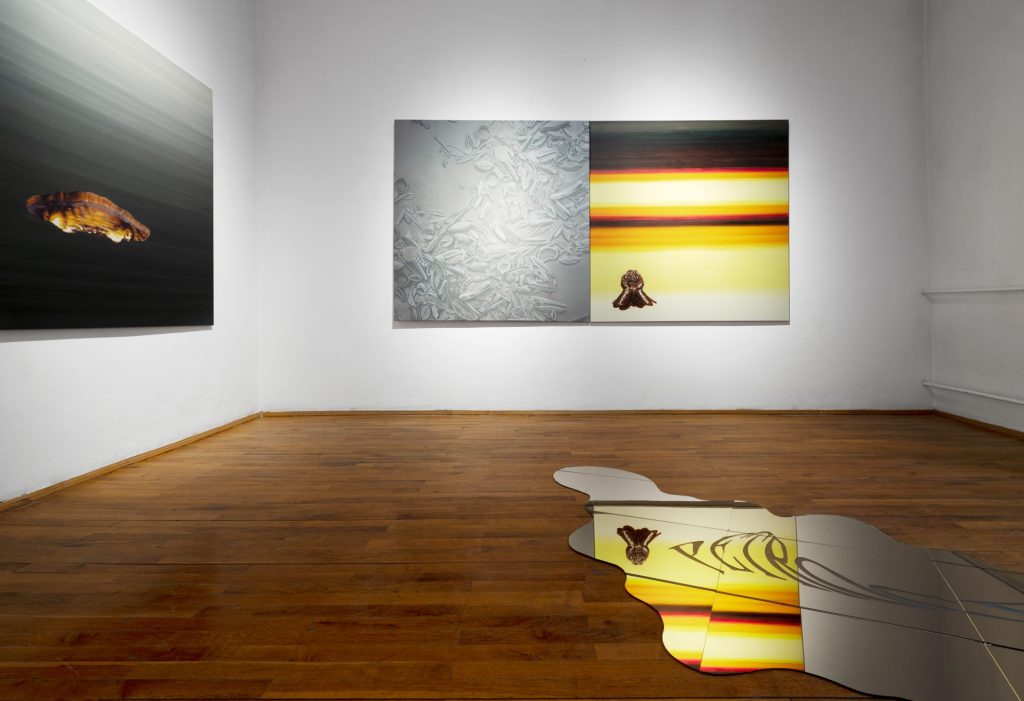
Süveges’ installation Petrocene (fig. 2) is an explicit reflection on the Capitalocene, which is allegorically and concretely dominated by oil (petroleum) and the oil-based capitalist economy.[14] Süveges confronts the culture of the industrial, toxic sublime (e.g. Burtynsky’s photographic landscapes of oil fields and surface mining) and the spiritual, abstract sublime (Rothko’s and Newman’s abstract canvases) with the specific sublime of self-organizing matter of almost infinite biochemical complexity. In the Petrocene installation, the diatom algae forming the oil shale, reminiscent of Ernst Haeckel’s marine biological atlases, form a strange triptych with a desert reminiscent of Barnett Newman’s strip paintings, where the oil spilling out of the ground resembles the figure of the liquid Terminator model (T-1000 in James Cameron’s famous film, 1991), and the inscription “petrocene” cut out of a mirror on the ground. In a weird philosophical fiction, Reza Negarestani interpreted petroleum as the inorganic demon of the Arabian desert.[15] The Iranian philosopher has combined the Mesopotamian mythology familiar from The Exorcist (1973) and the history of industrial and post-industrial cultures into a grand narrative where the Mesopotamian gods of epidemics and diseases, the agents of petrol-capitalist culture and the demons of cyberspace are intertwined. It was in William Gibson’s fictional cyberspace that strange artificial intelligences, imagining themselves as demons, voodoo spirits, whose thinking is not really comprehensible to human logic, first emerged.[16] In Negarestani’s theory-fiction, an inorganic and non-human demon like them, the chthonic oil under the desert, becomes the engine of a whole region’s history, from the devastating Iron Age nomadic wars and epidemics to the technocapitalist War on Terror (and actually on Oil). The Cyclonopedia is in fact a dark, vitalist and chaotic encyclopedia inspired by the sublime dark capitalism of Nick Land’s philosophy, combining Nietzsche’s nihilistic epistemology with Bataille’s “base materialism.”[17] In Negarestani’s world, the god-like demonic oil, created by the decomposition of tiny sea creatures, is charged with their non-human energies and agency, and its real purpose is to destroy human civilization, i.e. to break it down and decompose it, and to take over the Earth.

In Xtro Realm’s ACLIM (Agency for Climate Imaginary) exhibition, Gideon Horváth and Kata Dóra Kiss’ joint project, With their Mouth the Spirits Speak (2021), (fig. 3) is a reinterpretation of another regional mythology, Hungarian shamanism, from a cultural anthropological and new materialist perspective. According to the authors, the ancient shaman could be an excellent mediator in the post-Anthropocene world, mediating between capitalist human society and the energies of exploited nature. To visualize this, Horváth recreated ancient creatures and symbols such as the horse and the wolf, using beeswax and charcoal. He also reinterpreted such magical materials and objects as the ecstatic Fly agaric and the shaman’s “steed”, the shaman drum, the instrument of his psychedelic journeys. (fig. 4)

The use of sticky beeswax was inspired in part by Timothy Morton’s hyperobjects,[18] which are huge, unpredictably complex phenomena such as global warming, because hyperobjects are not only extremely complex but also viscous, sticking to us and impossible to get rid of. This is how the legacy of shamanism, once a tribal religion that dominated the beliefs of nomadic cultures from Siberia to the Urals and the Caspian Sea, and also determined the thinking of the Hungarian tribes that settled in Hungary, is also attached to us. The posthuman shamanism of contemporary art imagines a sustainable world in which we respect the spirit of living beings and things, preferably not harming them or wasting them in sacrifice to the “gods” of capitalism (wealth, civilization).
ALAGYA
The Alagya project (fig. 5) was created by Szilvia Bolla and Áron Lődi, whose chosen name reuses the old Hungarian word for elegy (elegeia), which rhymes with the Hungarian word “elegy” (mixture), meaning the blending and mixing of things. Their first exhibition, in 2021, is entitled First Songs of Sympoiesis, which leads to Donna Haraway and her theory of symbiotic autopoiesis.[19]

In Bolla and Lődi’s fiction, the specific autopoietic reality of organisms living in symbiosis with one another is presented as a strange visuality reminiscent of the worlds of new weird steampunk novels retrofuturistic genre, that blends nineteenth century technology with speculative innovations. They create hybrid, organic-mechanical creatures: the engine-block Bambi on the floor and the metal-plexiglass Butterfly resting on the wall are illuminated by a metal-neon Firefly. The creatures may also evoke the inhabitants of China Miéville’s fictive Bas-Lag world,[20] where we can also explore the minds of eagle-man, dung-beetle-woman and cactus-human hybrids under the aegis of a surreal hybridity. But there is also a giant, pan-dimensional moth that feeds on human thoughts and whose genetically encoded greed threatens the survival of the entire world. It was in the context of Miéville’s novels that the label “new weird” first appeared in literary criticism,[21] building on the topoi of Lovecraft’s old weird world and envisioning a new posthuman culture dominated by the non-human laws of Lovecraft’s Outside, which inspired the philosophy of Meillassoux, as well. Through their post-humanist elegiac texts, the creatures of the world of Alagya recall their origins, the former human culture, in a rather poetic way. In other words, the weird technofossils of Bolla and Lődi, the intelligent sympoietic (collectively produced) hybrids of machine wreckage and remnant living beings, tell their uncanny story of survival after the apocalypse of the human race.


Szilvia Bolla’s previous solo installation Prevail (2020) (figs. 6, 7) reflected on the strange, at once spiritual and patriarchal, fantastical and pragmatic culture of the previous turn of the century (around 1900) through the perspective of post-feminist Posthumanism.[22] The starting point is a seductive fairy by the Czech Jewish artist Lev Lerch in a painting Willow-the-wisp (1888), whose world Bolla realizes as an installation evoking cybernetic and gothic associations, based on the interplay of plexiglass, metal, neon and fog under the aegis of new materialism. The cybergothic installation is also linked to the culture of contemporary fantasy computer games, one of the most popular of which is The Witcher, based on the world of Polish author Andrzej Sapkowski.[23] Sapkowski combined dwarves and elves from the Celtic mythology made famous by Tolkien with magical creatures from the Central European beliefs, various vampires and ghouls, golems, evil fairies and shaman assassins. Bolla, on the other hand, took his inspiration from the bourgeois culture of the Austro-Hungarian Empire, which was also based on this complex magical belief system, as exemplified by the decoration of the Lindenbaum House (1897) in Pest, whose fairies, reminiscent of nymphs and caryatids, also recall Lev Lerch’s wraith, who lures men into the swamp with her beautiful body and charming voice. (fig. 8)

In Bolla’s neo-materialist reading, however, it is no longer the evil fairy, who becomes a supporting character, but the swamp itself that triumphs: the rotting plants and the willow-the-wisp itself take on crystalline form, and the entire installation is filled with the neon light of virtual reality, cyberculture, which radiates a happy and problem-free eternity.

In his solo project Metallurgia,[24] (fig. 9) Áron Lődi is haunted by the sublime ruins of industrial culture and the ghosts of the proletariat, which the artist realizes through a strange material culture. Lődi has collected the Gothic-inspired dreams of real Hungarian metalworkers, in which both the huge abandoned machines and the fossils of prehistoric times, well before the industrial age, come to life, which also relates to the geological past of the materials used in metallurgy. Like Robert Smithson,[25] the metallurgical equipment, no longer used and discarded, and overgrown by vegetation, reminds Lődi of prehistoric creatures. This is partly because the site of the Danube Ironworks was once the site of a rich paleo-culture, with mammoth bones and tusks being found during construction work. According to Lődi’s interpretation, these ancient beings and the spirits of iron and steel haunt the abandoned Ironworks’ steel lockers. The huge claws that appear in one of the lockers evoke both prehistoric predators and the armored ghost of the Otranto Castle (1764). In Lődi’s fiction, imbued with the spirit of panpsychism,[26] the material itself, ore, coal and limestone, is remembering through the dreams of the workers, symbolized by the metal hands made with a 3D printer that hold the dreams of the workers up to the visitor. According to Gilles Deleuze and Jane Bennett,[27] the specific organization and autopoiesis of metals also affects people working with metals, and the non-hierarchical structure of metal, its specific chemical “nomadism,”[28] can be paralleled with the coalition structure of anarchist workers. The workers at the Danube Ironworks may also be influenced by the mammoths and metals in their dreams, or at least be made to reflect on the relationship between the present and the past, and on the fiction of a new sustainable future that would follow the ecological logic of inorganic matter and prehistoric beings rather than humans.
WOFT
The WOFT is formed by Martina Bús and Dániel Kophelyi, their name is a well-known abbreviation of gamer slang (Waste Of Fucking Time), which they reinterpret from the perspective of a new materialist ontology. The neologism of “woft” combines the meanings of wet and soft, which points towards an abject materialism, since, from the point of view of Julia Kristeva and Georges Bataille’s abjection,[29] death is a disgusting, slimy and disturbing process, whereby the solid human body becomes liquid and amorphous as it decomposes. However, according to the mythology of modern science fiction, and specifically the film Prometheus (2012), death can also give rise to new life, at least in the world of the Alien (1979). In this fiction, our creators are actually humanoid aliens who have fertilized the Earth’s primordial ocean with their own DNA. Ridley Scott’s Engineers, however, are not Erich von Däniken’s alien gods in space suit, but postmodern versions of William Blake’s and John Milton’s fallen angels, who inspired the heroes of WOFT’s first programmatic work, the performative installation Wrap Over False Terrain (2020). (fig. 10)
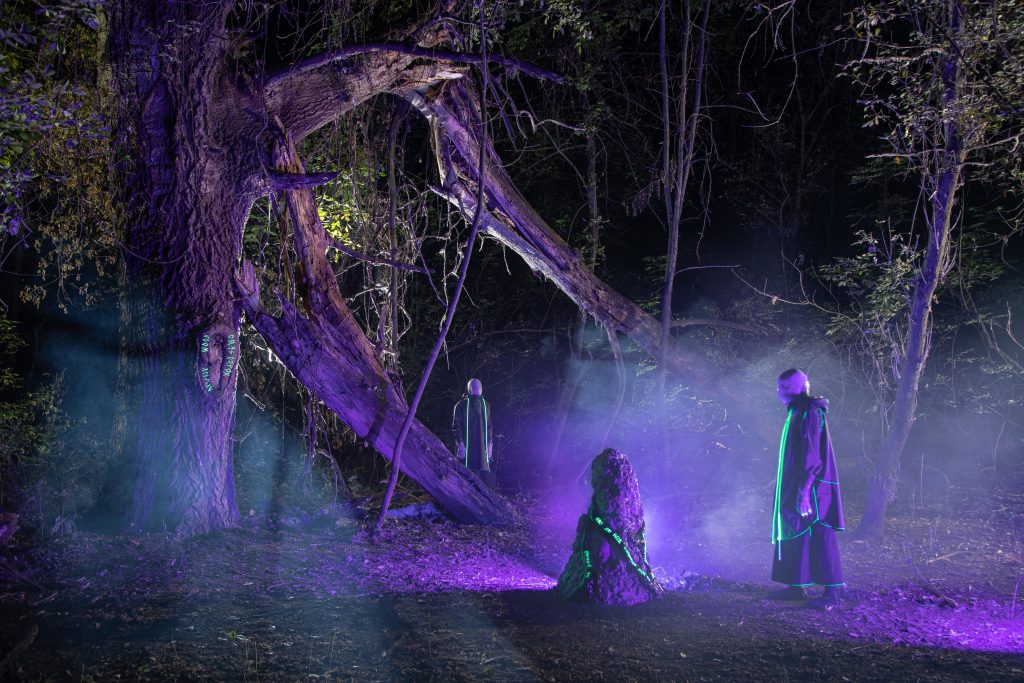
Fig. 10. WOFT, Wrap Over False Terrain, 2020. Mixed media installation, Csongrádi Művésztelep. Photo Barnabás Neogrády-Kiss, courtesy of the artists
The title combines Borges’ and Baudrillard’s famous world model with the fiction of Prometheus and exogenesis. In Jean Baudrillard’s hyper-real world,[30] reality is inextricably intertwined with its artificially created representations, Jorge-Luis Borges’ famous map completely envelops the landscape, we do not know what is real and what is fiction. In WOFT’s performative fiction, creatures that resemble alien engineers or surreal puppets – the artists themselves – create an intelligent volcanic rock. Magical phosphorescent inscriptions and cyberpunk runes bring the inorganic material to life, reminiscent of the famous monolith in 2001 Space Odyssey (1968), which taught cavemen how to use fire, tools and language, among other things, as cybernetic Prometheus.

In the spirit of new materialism, Bús and Kophelyi also use strange materials, phosphorescent paint, luminous ropes, synthetic plasticine, and natural materials such as mushrooms. Kophelyi’s solo work, the Glow Down installation, (fig. 11) is specifically an ironic twist on a glow paint brand. The magical runes there seem to be remnants of the web that destroyed the world, mocking inhuman memes (“Sub Pussy,” “Buddy Retard”) that also haunt a world where life is carried on only by lowly creatures, decay products of a former human culture. One of these creatures, the strange, crystalline-looking Lion’s mane mushroom, also links posthuman fiction to the older aesthetics of surrealism. André Breton, in his aesthetic treatise L’amour fou,[31] wrapped in fiction, used Brassai’s crystals to illustrate his “fix-explosive” aesthetic. In fact, inanimate crystals have a mysterious “life, ” they are orderly and even growing, but they are inorganic organisms. Actually, Breton and the Surrealists were the first to transpose wonder and magic into high art. A well-known case of this is the duo of Max Ernst and Leonora Carrington, who presumably inspired WOFT. Max Ernst updated the metaphysical painting of Giorgio de Chirico with the magical, hybrid cosmology of alchemy,[32] while Leonora Carrington combined the traditions of English Romanticism with Celtic mythology and matriarchal fictions of witchcraft.[33] WOFT has transposed all this to the fantastical setting of the entertainment industry, where mould and slime survive everything in the interplay of myriad organic and inorganic components. Slime fungi are wreaking havoc on humanity in one of the most successful video games of our time, The Last of Us, and in the new weird world of Southern Reach, slimy human-animal-fungus hybrids with their DNA scrambled by alien intelligence are surviving.[34] This surrealist-rooted, modern, gothic fantasy culture becomes a dark and complex model of the world in Ben Woodard’s philosophy, inspired by Negarestani, where a dark (inhuman) version of Bennett’s and Deleuze’s inorganic vitality (Bennett’s vital materialism and Deleuze’s material vitalism) takes the world towards ultimate destruction, towards total entropy.[35]

WOFT’s exhibition Let the Jinx Come (2022) (fig. 12) could be an allegory of this theoretical history, which ranges from surrealism to contemporary dark vitalism. Bús and Kophelyi transfer the illusions of Max Ernst and René Magritte into the modern age of simulations, populated by fairies, witches and monsters in the popular worlds of League of Legends and The Witcher. In their exhibition, it’s as if Magritte’s hooded-faced lover (Lovers, 1928) is brooding in a secret shelter, unknown whether he is human, alien or some kind of magical creature.

Surrounding him are cult objects and images with a gothic atmosphere, as well as a curious altar-like object inspired by Ernst’s painting At the first clear word (1923), (fig. 13) but in this cultic context it seems to be a representation of Creation. Ernst’s painting once adorned the house of Paul Éluard, inspired by his strange surreal love poem, but the real inspirations are more complex, as the main motif of the painting is a curse-wielding hand gesture, a sign of jinx in English culture, which can be traced back to early Christianity and Christ crucified. In Ernst’s painting, however, the fingers, reminiscent of a woman’s legs, hold the weird fruit of a strange plant, which appears in a space reminiscent of metaphysical painting. Ernst has taken the motif from a psychological article about how touch can be easily deceived, as the crossed fingers detect two balls when there is only one.

Fig. 14. WOFT, Let the Jinx Come, 2022. Mixed media installation (detail), FKSE, Budapest. Photo Barnabás Neogrády-Kiss, courtesy of the artists
The slimy ball of WOFT’s Jinx altar is a symbol of wholeness, (fig. 14) of the Earth, and also harkens back to the Promethean scene in Wrap Over False Terrain, where aliens create life on Earth and human culture from slimy goo. The WOFT also eerily objectifies the fictions of virtual reality, with Jinx being the name of the anarchist revolutionary of the town of Piltover (in League of Legends), a multi-talented young woman from the poor underworld who seeks to overthrow the capitalist autocracy of the upper world. But the outcome of WOFT’s fiction is reminiscent of the theoretical fictions of dark vitalism: revolution and war ultimately bring only destruction, on the ruins of which strange creatures gather and remember their former creator, who left them to their own devices to achieve their inglorious end.
A distinct trend is emerging in Hungary: a surrealist, modern Gothic fantasy world blending dystopian elements and decaying industrial landscapes with fantastical, magical creatures. This post-apocalyptic fantasy stems from current anxieties about ecological catastrophes and wars, reflecting collective fears and reimagining a more inclusive posthuman future, a new weird world.
Sándor Hornyik is an art historian and curator working for the Institute for Art History of the Research Center for the Humanities (ELTE). He has a PhD in art history (2005, Eötvös Lóránd University Budapest). His research concerns the history and theory of avant-garde and neo-avant-garde art as well as the theoretical issues of contemporary art and visual culture studies. He published books on the neo-avant-garde reception of modern natural sciences (Avant-Garde Science) and on the intersections of iconology, visual studies and contemporary art (Idegenek egy bűnös városban [Aliens in a Sin City]). Between 2012 and 2014, he was the chief curator of MODEM (Museum of Modern Art Debrecen) where he curated several exhibitions dealing with socialist and post-socialist visual cultures. He also curated exhibitions in Maribor (Foreign Matter: Surrealism in the Attraction of Reality, National Liberation Museum, 2012), in Riga (“Other” Revolutionary Traditions, Riga Arts Space, 2011), and in Paris (Cosmologie quotidienne, Institut Hongrois, 2012). In 2018, he co-edited an English volume on the Hungarian art of the 1950-1960s (Doublespeak and Beyond: Art in Hungary, 1956-1980, Thames and Hudson, London). In 2021, he acquired the Doctor of Sciences title of the Hungarian Academy of Sciences with his book on the iconological analysis of Hungarian Surnaturalism (A szürnaturalizmus archeológiája [Archeology of Surnaturalism]).
[1] Howard Philips Lovecraft, The Call of Cthulhu, (1926) https://www.hplovecraft.com/writings/texts/fiction/cc.aspx , Howard Philips Lovecraft, Supernatural Horror in Literature, (1927) https://www.hplovecraft.com/writings/texts/essays/shil.aspx
[2] The first season of True Detective (showrunner: Nic Pizzolatto, HBO) was inspired by Thomas Ligotti, Stranger Things (showrunners: Duffy Brothers, Netflix) sends its alien “divine” entity into the real world as intelligent, amorphous material reminiscent of Lovecraft’s Shoggoth, and Lovecraft Country (showrunner: Misha Green, HBO) is based on the Matt Ruff novel of the same title (2016), which combines Lovecraft’s fantastical world with Southern Gothic. See also, from the world of philosophy, Reza Negarestani, Cylonopedia: Complicity with Anonymous Materials (Melbourne: re.press, 2008); Timothy Morton, Dark Ecology: For a Logic of Future Coexistence (New York: Columbia University Press, 2016), Graham Harman, Weird Realism (London: Zero Books, 2012).
[3] Friedrich Nietzsche, On Truth and Lies in a Nonmoral Sense (1873) https://dn790002.ca.archive.org/0/items/NietzscheTruthLiesInANonmoralSense1873/Nietzsche%20-%20Truth%20%26%20Lies%20in%20a%20Nonmoral%20Sense%20%281873%29.pdf
[4] Gilles Deleuze–Félix Guattari, Mille plateux (Paris: Minuit, 1980).
[5] Bruno Latour, We Have Never Been Modern (Cambridge: Harvard University Press, 1993).
[6] Donna J. Haraway, “Anthropocene, Capitalocene, Plantationocene, Chthulucene,” Environmental Humanities, no. 6 (2015): 159-165.
[7] Iris van der Tuin–Rick Dolphijn, New Materialism: Interviews and Cartographies (Ann Arbor: Open Humanities Press, 2012). Cristoph Cox – Jenny Jaskey – Suhail Malik (eds.), Realism – Materialism – Art (Berlin: Sternberg Press, 2015).
[8] Quentin Meillassoux, Science Fiction and Extro-Science-Fiction (Minneapolis: Univocal Publishing, 2015).
[9] Quentin Meillassoux, After Finitude: An Essay on the Necessity of Contingency (London: Continuum, 2008).
[10] Extrodaesia: Encyclopedia towards a post-anthropocentric world, ed. Xtro Realm (Budapest: Typotex, 2019).
[11] Rita Süveges, “Beyond the Postcard: An Ecocritical Inquiry on Images of Nature”, in Climate Imaginary Reader, ed. Xtro Realm, Mezosfera, 9 (2020). http://mezosfera.org/beyond-the-postcard-an-ecocritical-inquiry-on-images-of-nature/
[12] Rita Süveges, Kietlen lankák (Ridge of Doom), Szent István Király Múzeum, Székesfehérvár, April 28 – May 22, 2022.
[13] Jennifer Peeples, “The Toxic Sublime: Imaging Contaminated Landscapes,” Environmental Communication, (2011) https://www.academia.edu/25593456/Toxic_Sublime_Imaging_Contaminated_Landscapes
[14] Stephanie LeMenager, Living Oil: Petroleum Culture in the American Century (Oxford: Oxford University Press, 2014).
[15] Negarestani 2008.
[16] See the cyberpunk Sprawl trilogy of William Gibson: Neuromancer, 1984; Count Zero, 1986; Mona Lisa Overdrive, 1988.
[17] Nick Land, Fanged Noumena: Collected Writings, 1987-2007, ed. Robin McKay and Ray Brassier, (London: Urbanomic, 2011).
[18] Timothy Morton, Hyperobjects: Philosophy and Ecology after the End of the World (Minneapolis: University of Minnesota Press, 2013).
[19] Donna J. Haraway, Staying with the Trouble: Making Kin in the Chthulucene (Durham: Duke University Press, 2016). Humberto Maturana – Francisco J. Varela, Autopoiesis and Cognition: The Realization of the Living (London: Reidel, 1980).
[20] China Miéville’s Bas-Lag trilogy: Perdido Street Station, 2000; The Scar, 2002; Iron Council, 2004.
[21] The New Weird, eds. Ann and Jeff Vander Meer (San Francisco: Tachyon, 2008).
[22] Rosi Braidotti, The Posthuman (Cambridge: Polity Press, 2013).
[23] In the 1990s Andrzej Sapkowski created the Witcher (in polish: Wiedźmin) universe, a series of five novels and several short stories, which was published in English from 2008 onwards. The Witcher RPG computer games have been in development since 2007. Netflix has been producing The Witcher series since 2017.
[24] Barnabás Zemlényi-Kovács, “Fantomvégtag, vasököl. Kommentár Lődi Áron Metallurgia című kiállításához” (Phantom limb, iron fist. Commentary to Áron Lődi’s Metallurgia exhibition), in Metallurgia,exhibition guide (Budapest: 1111 Galéria, 2024), 2–6.
[25] Robert Smithson, The Tour of the Monuments of the Passaic (1967) https://holtsmithsonfoundation.org/tour-monuments-passaic-new-jersey
[26] Bennett, from Spinoza to Bergson to Deleuze, reinterprets the theory of panpsychism, which attributes soul and agency to inanimate matter, and which he calls “vital materialism”.
[27] Jane Bennett, Vibrant Matter: A Political Ecology of Things (Durham: Duke University Press, 2010). See also: Deleuze–Guattari 1980.
[28] Nomadism, in the Deleuzian sense, is a natural, physical-biological organization, a kind of process („becoming,” devenir), which, in his view, determines the structure and functioning of the non-human and human world.
[29] Julia Kristeva, Powers of Horror: An Essay on Abjection (New York: Columbia University Press, 1982). Georges Bataille, “L’abjection et les forms misérables” (1934), in Œuvres complètes, II, Écritsposthumes 1922-1940 (Paris: Gallimard, 1972), 217–221.
[30] Jean Baudrillard, Simulacres et simulation (Paris: Galilée, 1981). Jean Baudrillard, L’echange symbolique et la mort (Paris: Gallimard, 1976).
[31] André Breton, L’amour fou (Paris: Gallimard, 1937). See also In Search of the Marvelous: Surrealism, Occultism, Politics, eds. Tessel M. Bauduin – Victoria Ferentinou – Daniel Zamani (London: Routledge, 2018).
[32] M. E. Warlick, Max Ernst and Alchemy: A Magician in Search of Myth (Austin: University of Texas Press, 2001).
[33] Darran Anderson, “Leonora Carrington: The Celtic Surrealist, Studio International, September 12, 2013, https://www.studiointernational.com/leonora-carrington-the-celtic-surrealist
[34] The Last of Us RPG computer game was published by Naughty Dog in 2013, and a series based on it was launched on HBO in 2023. Jeff Vander Meer’s Southern Reach trilogy: Annihilation; Authority; Acceptance (New York: Farrar, Straus and Giroux, 2014). Alex Garland made a film of the trilogy (Annihilation) for Paramount Pictures in 2018.
[35] Ben Woodard, Slime Dynamics (New York: Zero Books, 2012). Ben Woodard, On an Ungrounded Earth:Towards a New Geophilosophy (New York: Punctum Books, 2013).


