Full moon, red. Cracks in the soil, the size of crevasses. Patching the land, maintenance that takes much more struggle than building. Plants that made the effort of surviving sequences of frost, that generated new leaves, new sprouts, a new generation of themselves, better adapted to the conditions of their host garden, only to be menaced again, by the drought. If they die again now, it will have been our responsibility. Keeping enough plants with flowers in bloom, throughout the seasons, also our responsibility. For the insects, the birds and other critters. Managing the water so not a single drop is wasted. Imagining a garden for the next fifty years. Without any guarantee we are still here for the next ten. Or even for less.
In 2021, a group of us bought a plot of land, in the proximity of Bucharest, in co-ownership, in the middle of the Covid pandemic. On this land grows The Experimental Station for Research on Art and Life,[1] a place where we test the conditions of future climate, against the background of current political turmoil and economic breakdowns. (fig. 1)
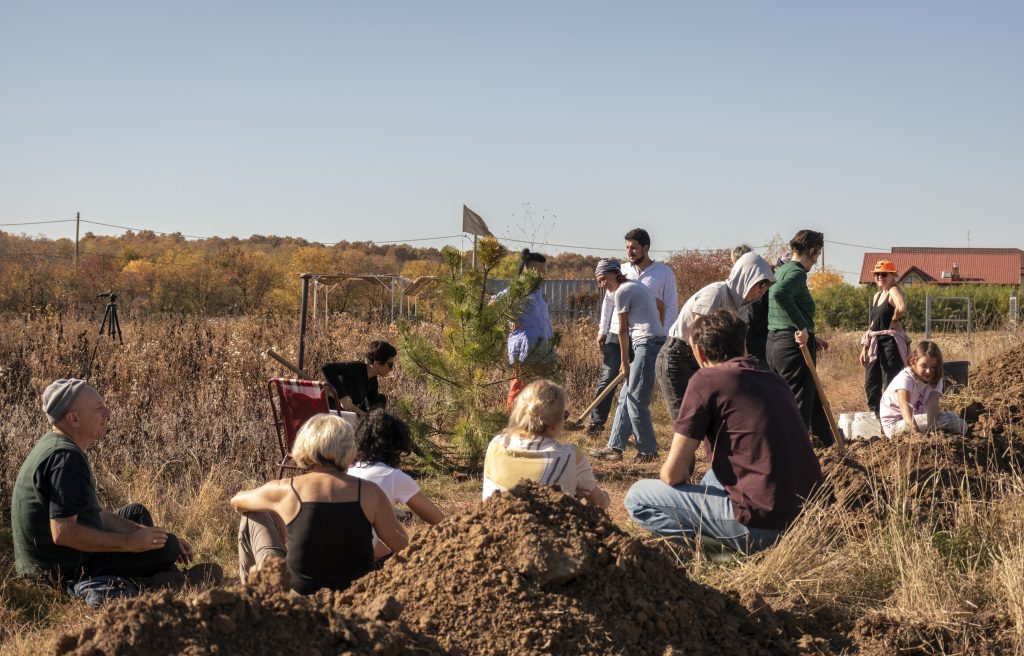
Where we can see what is possible through collective effort that wouldn’t otherwise happen in a fragmented world. Where we grow a garden, we build ecological infrastructures, we make alliances and cooperation frameworks with other such spaces, we try to inspire cultural practices that are less extractive and to negotiate our role in a rural mindset dominated by nationalism and conservative values.
Tomatoes grown by neighbors only in greenhouses. In all the villages of the southern part of Romania, tomatoes and vegetables are grown in greenhouses. Outside, the weather is too unpredictable and can destroy entire crops in a few hours. Cracks in the soil, the size of crevasses. A soil that has been degraded after years of intensive agriculture, of monocrops and pesticides. Young people in cities becoming interested in permaculture, living seeds, regenerative agriculture. Already since more than a decade. Some of them have meanwhile moved to the countryside.
In 2017, a Romanian man returned from London and, determined to relocate to a healthy life in an Apuseni village, he also founded a Facebook group called Moved to the countryside. Life without a clock.[2] In 2025, that group has more than 350.000 members, with additional groups based on topics or counties and a yearly festival in two regions of the country. Not only the online community interested in topics related to rural living has grown, especially during and after the pandemic, but also the actual people who have made this move, many of them returning from diasporas. Apart from picturesque and well-preserved Transylvanian villages, the choices are usually for peri-urban areas, close to the big cities, in places that offer some infrastructure (especially internet), and easy access to transport means and connection to the larger cities.[3] Profiles of people who do this move vary, yet many of their reasons coincide: overwork (or loss of jobs) and the need for a reset; the need to breathe clean air and eat the food they produce; return to traditions that are almost disappearing, more rarely the need for a community they miss in the urban context; mostly, the need to raise children in a healthy environment, in the arms of a harmonious nuclear family, surrounded by nature and, surely, complying to God’s expectations (in more rare cases, God is replaced by some form of spiritual reconnection to the land).
Before the Station, there was a permaculture garden experiment in Bucharest, where we discussed the Anthropocene and nineteenth-century utopias, where we planted in order to harvest social relations, where we learnt to observe the living without extracting too much, to decolonize our vocabularies on nature and the natural, and imagined possibilities for continuing to grow such a garden beyond the menace of eviction in a rapidly gentrifying neighborhood. We took some of the plants and all the knowledge, some of the patience and most of the hopes for adaptation, and moved on to imagine another garden to turn even more into a place for collective learning.
Seeds exchange and gifted plants; willows that don’t have enough water, despite the closeness to the lake; hazels and witch-hazels; Jerusalem artichokes, Damascus roses and Lebanese cedar; Austrian pine, Japanese cherry, Russian sage; Cosmos flowers, a desert rose from Senegal, locally-grown kiwis and figs and pomegranate and Sichuan pepper. The garden accommodates all of them, as long as they adapt. Cracks in the soil, the size of crevasses. Trying to take out from the descriptions of plants words such as invasive, weed, exotic.
In November 2024, in Romania, Calin Georgescu, a presidential runner virtually ignored by all the mainstream media before the elections, managed to secure the first place for the run-off, after an aggressive TikTok campaign and presumably some forms of foreign interference. Chances are, had the Constitutional Court not cancelled the first round, he would have won the elections, with the prospect of a far-right dictatorship returning to the country. His electoral platform, conspirationally channeled through youtube videos, was framed by the slogan “Food, water, energy” and included, often in phantasmagoric formulations (despite his doctorate in soil science), the promise of a land which natural resources are given back to the people, i.e. the true Romanians, patriotic, anti-globalist, treasuring the family and the Christian values. When the presidential elections were reorganized, six months later, his supporter and a contender in the 2024 elections himself, the more predictable George Simion, leader of the far-right party AUR (Alliance for the Union of Romanians, which has been a Romanian parliamentary party since 2000), won the first round. The ecological red line united the two candidates, with Simion and AUR consistently building this discourse around ethno-nationalistic and anthropocentric Orthodox backbones. “By exploiting geopolitical resentment and reactive pride, [AUR] has actively supported valid ecological causes, ranging from organic, local food production to the protection of Romanian forests and biodiversity conservation, emphasizing the link between socio-economic and ecological injustices. However, its religious-national sovereignism based on an imagery of a patriarchal and ethnic-territorial wholeness provides a parochial and undemocratic basis for a much-needed transnational and inclusive ecological agenda. In practice, its defense of fossil fuel-based energy in the name of energy independence, its lack of a robust problematization of the local capitalist dynamics, as well as its rejection of the European Green Deal shows its limitations when it comes to the global challenges posed by climate change and biodiversity loss.” [4]
As it becomes increasingly difficult to disentangle people’s desires for a good life in harmonious coexistence with the natural realm from the definition of this life based on conservative values that support the far-right ascension to power, we see our work at the Station as a mediation between the many worlds we move in (including the rarefied world of contemporary art), and the land which we steward and which guides our practice, a mediation that can offer other forms of relationality and discursive contextualization, embedded in the understanding of historical processes, an ethics of care and a concern for a more just future. In this process, we see ourselves as a fragile piece on a map of similar practices, to which we reach out, try to collaborate and exchange with, in the hope that together our work makes more sense. Our position at the periphery of Europe and after more than three decades of transition to capitalism is situated on constantly moving ground, making us question not only the vocabularies we use, but also their historical genealogies. We understand, also by looking at the ways in which “far-right ecologism”[5] is abusing the legitimate (re)turn to nature, that “re-orienting sensibilities”[6] towards a non-extractive attitude of coexistence with the rest of the living world is a process that requires time, collective thinking, reliance on complementarity of knowledges. (Some of this knowledge has been forgotten or devoid of meaning in their instrumentalization as national folkloric traditions.) Most of all, we are building alliances with other protectors of life, across a map that defies the current geo-political divisions, emphasizing instead the interdependence of territories and their stewards. (fig. 2)

A former field of wheat, treated with pesticides. From no insect four years ago, to species we never saw before, multiplying and diversifying every year. Lizards, a precious hedgehog, wild rabbits every now and then, birds, cicadas and crickets alternating in their concerts. The summer garden, looking completely dry during the day, and magical in the morning, with the blue chicory and the flower-of-an-hour and others that only bloom for an early and attentive eye. Cracks in the soil, the size of crevasses. 40°C during the day and tropical nights, not as many as last year, yet the cracks are much more intense. The accumulation of drought, making us wonder when the well will run dry. Full moon, red.
Around the time of leaving the garden in Bucharest, as a curator and art critic, I was losing interest in art works that represent nature, no matter how sophisticated their conceptual basis and/or formal materialization. Instead, I started looking with admiration to artists or other cultural workers who were committing their effort to growing real gardens, to spending time with the soil, reducing their expectations on the processes of growing and harvesting, sometimes collaborating with others in imagining the garden, other times opening up their spaces to different communities, cultural or not. Understanding that gardens are cultural expressions too, and that theoretical reflections should always accompany the bodily practice, precisely in order to avoid the instrumentalization of work by those who think they own the earth-related concepts and their spiritual derivations.
Nevertheless, situating the Station, it was important to relate it to similar initiatives and practices, in an empirical and subjective cartography, learning about artists who in their turn had started cultivating the land, planting trees, readjusting their existence, changing their artworks accordingly. Is there something in the artists’ motivations or approaches that differentiates them from other people who decided to follow this path of (re)connecting to the land? Is there some trigger of a different artistic subjectivity that occurs when working with the soil? Can their positions become exemplary, offering models, prototypes, ways out of self-centered consumption? It is not so clear, yet we talk about their practices and show their works emerging from these in exhibitions or projects, and we visit their garden projects, which energy transcends the exhibition spaces.
There is no exceptionalism in their initiatives, qualifying them as different from the “moved to the countryside” movement. Yet, they most often take the spaces of the gardens they care for, as invitations to relations, cooperation, reflection beyond the individual.
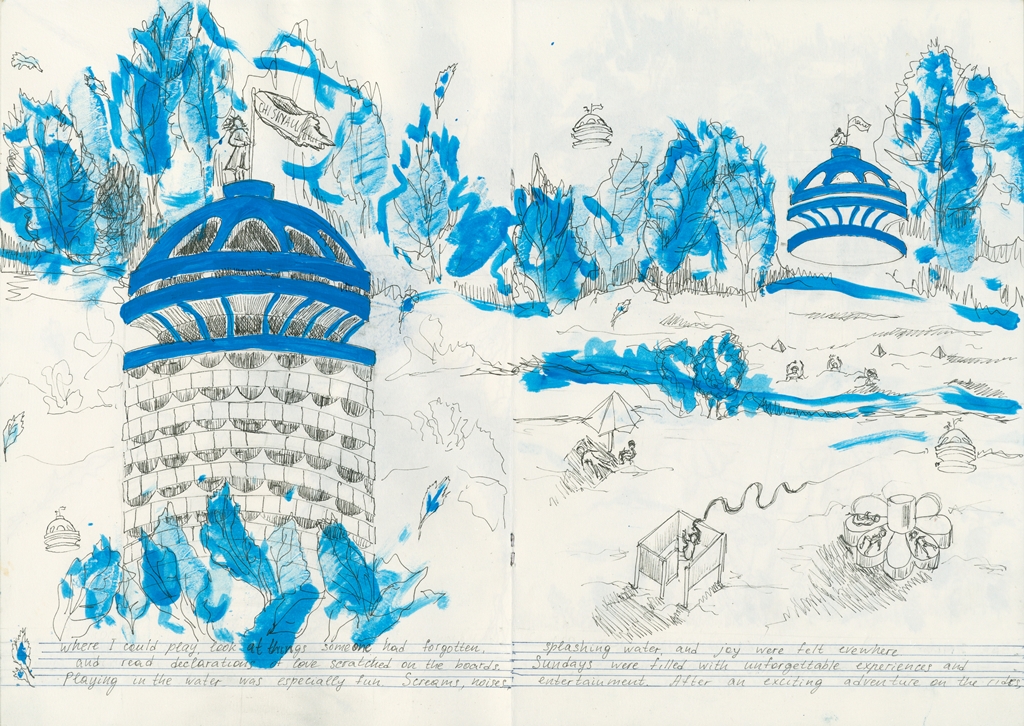
In 2021, with no previous knowledge of gardening, artist Tatiana Fiodorova started tending for the garden of her parents, in Scoreni village, Republic of Moldova. She learnt from her neighbor about vineyard and corn, she harvested fruit and vegetables, and then she understood these lessons as showing her a new path for her artist, as well as educator, role. (fig. 3 )

In 2022–2024 she travelled the villages of Moldova and made a series of plants and nature drawing workshops with children (from Moldova, and refugees from Ukraine) and senior people. In 2023, she started The Nettle (Urzica, fig. 4), a work that takes different materializations in exhibitions, for which she takes plants such as corn and nettle as delvers into her past, her childhood, the recipes and warmth of family together, the artist searching ways through the ruins of the past and seeking hope from the plants that survived first their colonial routes and then the harsh effects of the transition years in the former socialist countries.[7]
Bucharest-based Delia Popa has started building her artist studio in her grandparents’ house, some thirty-minute drive from the capital, and in the process, she started to connect to the village life, rituals, ways of growing vegetables, and slowly this life started to transfer into her works. (fig. 5)

“At Crețești I learned about the rituals of remembrance-burial, memorial service, death watch for grandparents and other relatives. I learned what good and bad neighboring means and I began making artworks in and about this place.(…) Since 2015 I started to build a studio place here in the former shed-garage of my grandparents, and in the years 2020-22 I lived here. Since then, I have been cultivating vegetables in the two greenhouses that belonged to my grandparents, especially in the weekends when I can dedicate myself entirely to this place and I see more and more the links between art and gardening.”[8] (Delia Popa). Delia is also an educator, both with an NGO she created some years ago, and in her job at the National Museum of Art of Romania. Since dedicating so much time to her studio-garden in Crețești, she started to organize creative activities for the children in the village and she is now considering reactivating the local cultural house. For both Tatiana and Delia, childhood memories are triggers for shaping their artistic identity and opening up new relationships to the places of their past, in a present which vitally needs the reactivation of rural communities, while their artworks transfer a more optimistic image of the village towards the cultural world. (fig. 6)

Although in a village that is not connected to a family memory, the house and garden in Rădești, south-western Romania, which artists Irina Botea Bucan and Jon Dean are tending for, is also a place for them to relate to the local people, from whom they learn and whom they engage with, including by making use of and talking about their skills, in gardening, pickling or carpentry. In 2024 (and continued in 2025), Irina and Jon managed to get a grant to go with a group of artists, musicians, anthropologists and others, to Fundata, a picturesque village in Brasov county, between two mountain chains, which is undergoing transformation due to its advertising as a touristic destination. With their project and participants, the artists involved the local community, especially women and children, and reactivated the Cultural House of the village, posing questions, together with the local inhabitants, about cultural infrastructures in rural and small communities as places for social life and intergenerational exchange. (fig. 7)
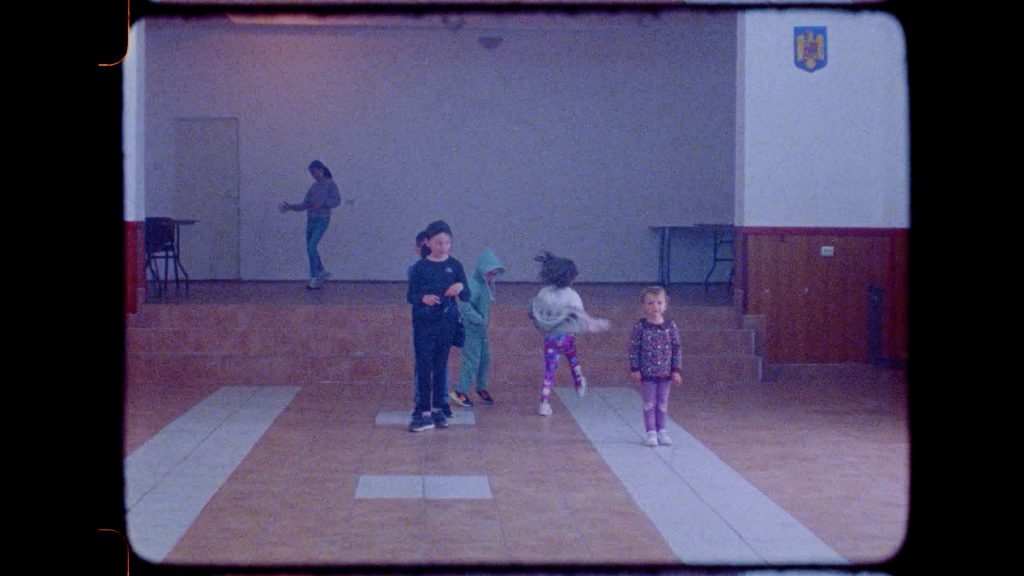
The “Moved to the Countryside” trend, appearing on the background of rural depopulation, did not contribute to local youth staying in their home villages, many of them continuing to search work in the urban environment or abroad. Instead, cultural initiatives such as the one of Irina and Jon, especially when they get the chance for continuity; and activist and political lobbying work such as the one deployed by Eco Ruralis, an association of peasants founded in 2009, “involved in the food production through subsistence and semi-subsistence agriculture, diversified and based on the principles of agro-ecology,”[9] these are types of positive engagement with the rural, which raise awareness of the local people to the possibilities they could access without being forced to leave or to emigrate. (fig. 8)
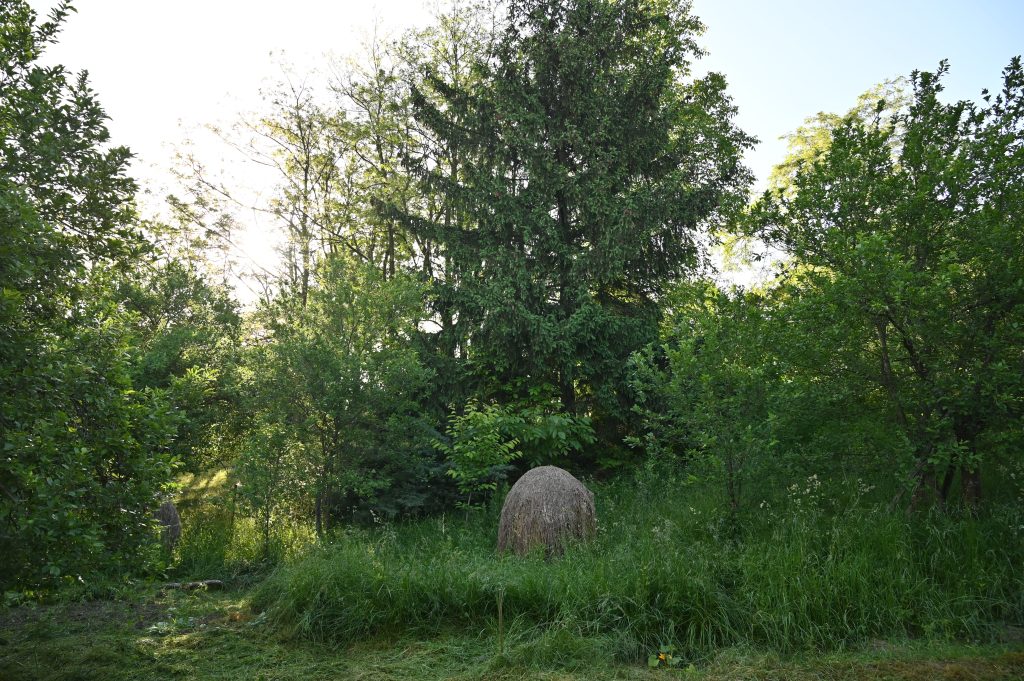
Stepping into an existing garden, or an infrastructure (courtyard, greenhouse) that has the memory of a previous garden triggers a lot of questions about continuity, belonging, success or failure. Other types of planting direct a very different process. In 2017, artist Martin Piaček started planting an orchard in Rajka, a little village at the border of Hungary and Slovakia. (fig. 9)

He made a bet on figs, as the local climate allows now for them to be grown, and complemented them with other fruit trees, apricots, plums, apple trees, walnuts, grapes, quince or pomegranate, according to a plan he drew (fig. 10), and in a long time of tending for them in-between his artistic work, teaching and family time.
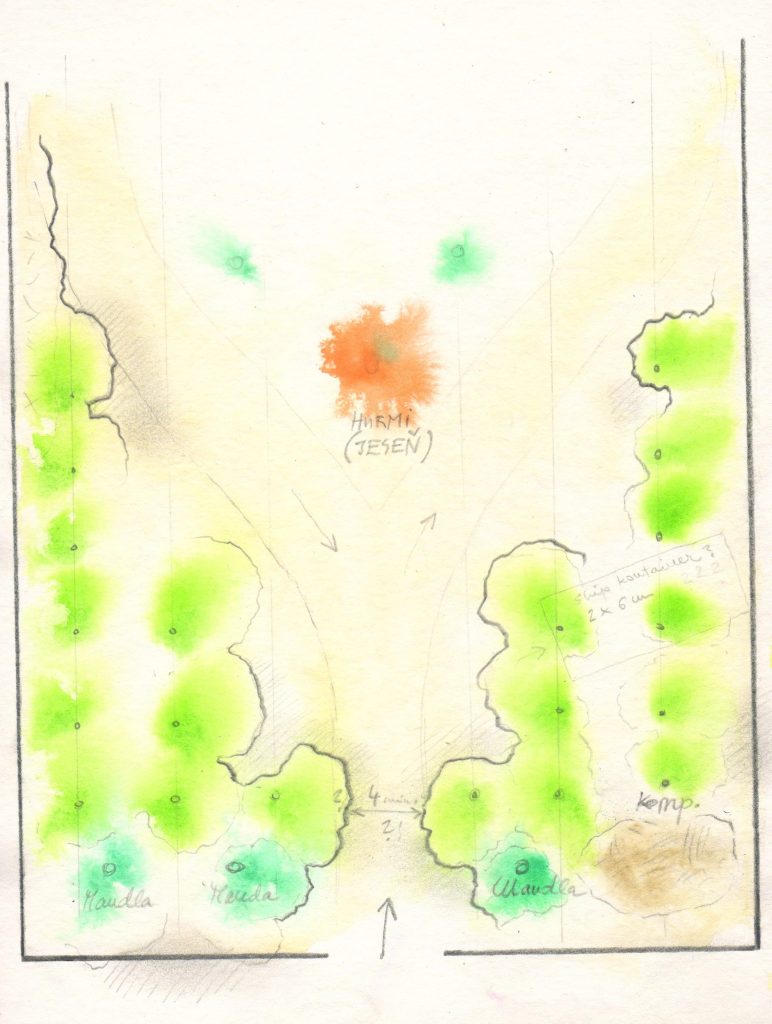
“The orchard creates a network of dynamic life situations that take place in real time. It is a space of temporalities and perpetuities, of permeability and flux, of the planned and the indeterminate. Plant time, however, is different from human time. Trees grow slowly, the long-living walnut tree begins to bear fruit after 10–15 years. Hence the melancholy, the feeling of the impossibility of achieving the desired goal: the orchard will only be fully productive in my old age. Based on these contradictions, the orchard is full of microcosmic potential; it gradually becomes an analytical site that not only represents a different perception of vegetation during our own time, but is a barometer of the landscape’s changing social and cultural environment. This offers a fertile ground for imagining alternative realities.”[10] (Martin Piaček) While the trees might not offer the rapid reward that a vegetable garden does, Rajka Orchard is a place of observation, of hospitality, where visitors or students can learn about changes in the climate or how to reconnect to the time of the land. “These times need projects like this” says Martin, who is building an ongoing research archive based on observing and thinking about/with the Orchard.

Oto Hudec’s garden in Košice was conceived as a place for living, growing and harvesting, as a gallery or backdrop/inspiration for his works that picture a dystopian future, much of which is already a reality.[11] A garden that he shared with a community of friends, the artist took not as a retreat but as a reminder of how these little pockets of peace and plenitude can be seen as testing survival pods, wherefrom we cannot forget the world is melting and falling apart (fig. 11). When he was not actively using it anymore, since 2022, the artist gave it for use to other people, refugees from Ukraine in the beginning of the war, and other communities later.[12]
Gardens as places of encounter between art and ecological awareness were proposed by Ilona Németh as her contribution to documenta fifteen in 2022.[13] (figs. 12, 13)


Cooperation: Off Biennale Budapest curators, Marian Ravasz (architecture); LABA—Michal Marcinov—Katarína Stanislavová (landscape architecture); Stefan Körner, Florian Bellin-Harder (expert consultations); Maximilian Mechsner (gardener); K&K Stauden (horticulture). Photo by and courtesy of the artist
Two floating gardens, a follow up of her public art–community project in Budapest in 2011, were researched, prepared, installed on River Fulda in Kassel and entrusted to volunteers to take care of them for the duration of the exhibition. Moving away from the French and English gardens she presented in Budapest, objects of contemplation in the spirit of modern Western appeal for aestheticizing nature and devoid it of its uses and interconnectedness, Ilona Németh shifted to gardens that respond to the current crisis, which comprises multiple effects. Researching with different specialists, she proposed a Future Garden, with plants adaptable to extreme weather conditions, and others that clean the soil of toxic substances, and a Healing Garden, understanding a medicinal garden in the ancestral ways of healing as a holistic practice, and including different spices, fruit, alongside herbs and vegetables, also considering the permaculture principles of good companionship of plants. Ilona’s project invited us to consider that experimental, research projects on gardens and nature have their role in shaping a different understanding of our relationship to an environment and countering the catastrophic scenarios with our modest means as cultural workers, in any way we can.
Every August, the cracks in the soil of the Station and the dried plants bring us to feel helpless and make the very idea of a garden unsustainable. Then, we turn our gaze to those plants that are thriving, we try to fill the cracks with a paste made from our clayish soil, not to let them grow wider, we take lessons from the wild plants that manage by themselves and let them coexist with the ones we planted, and to offer nectar to the insects, food to the birds and shelter to the lizards. Every August, the red full moon can be seen better and bigger above the garden.
In memory of my father, Cristian Voinea
Raluca Voinea is a curator and art critic based in Bucharest. Since 2012, she has been the co-director of tranzit.ro Association. Between 2012 and 2019 she ran tranzit.ro space in Bucharest. The ideas and approach that intellectually shaped that space have been continued in The Experimental Station for Research on Art and Life, a collective project and land-stewardship endeavor since 2021, realized by tranzit.ro together with a group of cultural workers in the village of Silistea Snagovului, 40 km north of Bucharest. Between 2008 and 2024 she was co-editor of IDEA. Arts+Society magazine. She was the curator of the Romanian Pavilion at the Venice Biennale in 2013, with artists Alexandra Pirici and Manuel Pelmuș. She has published in artists’ catalogues, anthologies, and magazines such as e-flux, Springerin, Cutra, Flash Art, Zeppelin, Mezosfera and others. She co-authored with Iulia Popovici the book Metaphor. Protest. Concept–Performance Art in Romania and Moldova (Cluj: IDEA Publishing House, 2017).
[1] https://internationaleonline.org/contributions/to-build-an-ecological-art-institution-the-experimental-station-for-research-on-art-and-life/
[2] https://www.facebook.com/groups/740526862768545/about ; meanwhile the movement has also its own dedicated website: https://mutatlatara.ro
[3] https://panorama.ro/rural-mutat-la-tara-fenomen-infrastructura-romania/#:~:text=Din%20punct%20de%20vedere%20demografic%2C%20satele%20nu,se%20duc%20s%C4%83%20g%C4%83seasc%C4%83%20sau%20reg%C4%83seasc%C4%83%20%27natura%27
[4] Mihaela Mihai, Camil Ungureanu, Far-right Ecology and Geopolitical Resentment at Europe’s Periphery: The
Case of Romania’s “Conservative Revolution,” Geoforum, no. 156 (November 2024). https://www.sciencedirect.com/science/article/pii/S0016718524001830?via%3Dihub
As the authors of this article show, AUR coopts and instrumentalizes not only the green vocabulary, but also other progressive themes, such as anti-colonialism or the critique of extractive capitalism from the position of the periphery.
[5] Ibid. The authors situate AUR within “’far-right ecologism’ (FRE), a broad ideological constellation including different fascist, conservative, and national populist variants.” (p. 2)
[6] This is one of the tasks that theorist and Station’s co-founder Ovidiu Tichindeleanu proposes for our work with the land and our rethinking of a cultural institution based on ecological grounds. It was also one of the guidelines around which he structured the one-year freestanding course “Non-Western Technologies for the Good Life”, which he led in 2023–2024, part of which took place at the Station. (https://ro.tranzit.org/en/project/0/2023-11-01/non-western-technologies-for-the-good-life)
[7] https://tatianafiodorova.wordpress.com/2024/06/18/artistic-research-in-buchsenhausen-innsbruck-austria-entitled-in-ruins-in-search-of-identityby-tatiana-fiodorova-lefter-october-2023-may-2024/
[8] https://ro.tranzit.org/en/project/0/2025-07-26/the-links-between-art-and-the-garden
[9] https://www.ecoruralis.ro/despre-noi/asociatia/
[10] Quotation from a text sent by the artist to the author.
[11] https://www.youtube.com/watch?v=kBnPiVymRjw
[12] E-mail conversations with the author in 2022 and 2025.
[13] See the publication dedicated to this project, Ilona Németh, Future Gardens(Bratislava: Abacus+, 2025), with texts by Eszter Lázár, Nataša Petrešin-Bachelez, Florian Bellin-Harder, Raluca Voinea.


