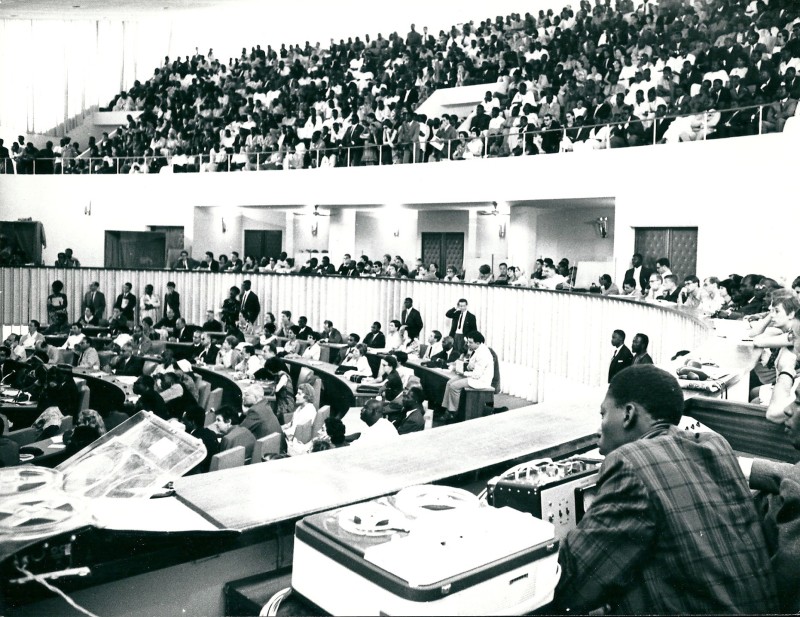
One of the founders of the LEF group, active in Odessa and Moscow since 1922, Boris Arvatov undertook to define proletarian art. In his 1922 text Proletariat and Left-Wing Art, he wrote: “Proletarian art, which has not even been heard of yet, is possible only as socially conscious art, art that is inextricably and deeply connected with life, developing alongside it and emerging from it. The fundamental characteristic of bourgeois art, on the other hand, is that its forms live and operate outside and above reality, in a firmly established, eternal form. It is therefore quite obvious that relying on these non-real, individualistic forms is to cut oneself off from the path to proletarian art. Only the destruction of these forms, their decomposition into elements, and liberation from the fetishism of aesthetic self-purpose can pave the way for limited artistic creativity,” concluded Arvatov. Left-wing art, identified by Arvatov with left-wing abstractionists, was, in his view, “a bridge over which the working class will inevitably have to cross to reach the shore of its own creativity.”[1] A proletarian artist is one who, instead of starting from form, reflects on the social task of art, seeking a purposeful form.[2] In order to understand the essence of theoretical texts on Marxist aesthetics written in the post-revolutionary years, it is necessary to realize that art defined as proletarian was to follow left-wing art, which served as a bridge—in a communist future that remained closely linked to the present. Art defined in this way was only one of the effects of the abolition of the division of labor, which was to be constitutive of the new society.[3]
As Piotr Piotrowski argued, art is inextricably linked to politics, and art which renounces politics simply conceals and neutralizes certain strategies of power, art not only can, but must be political.[4] This must however have different aspects. It refers to necessity, obligation and social demands on art. Necessity stems from the fact that art functions within a web of social, cultural, market and economic processes, which are obviously not politically neutral. Obligation is ethical in nature and I understand it as the expectation that art should be responsible for pointing out the mechanisms within which it functions. Art is obliged to be political, because only by revealing the ways in which it is entangled in politics can it demonstrate responsibility for this intertwining. The claim, in turn, concerns the expectation that art will point to its own conditions rather than passively submit to them. According to critical and Marxist theories and to our perspective Art as such does not exist. What exists is artistic work, not its mythologized domain in the form of an elite club, admission to which is determined by enigmatic criteria. Hans Abbing and Julia Bryan-Wilson wrote about this in texts that reveal the mechanisms behind the poverty of artists.[5] So, who should these claims of political nature be directed at if not at a convenient, universalized entity/object of art? This question becomes all the more relevant given that, as Kuba Szreder argues, these issues are also linked to the “myth of individual authorship,” which “is a fetish of the art world.”[6]
What interests me is the question of “contemporary socialist realism.” It is striking that Arvatov’s definition of proletarian art, quoted above, is surprisingly relevant more than 35 years after the so-called fall of communism in Europe. One could say that the division of labor in contemporary art has been effectively abolished: today you do not need an art education to create art. On the other hand, art is entering domains that were previously reserved for sociological, political, and other types of work. Class divisions remain intact, and it is contemporary art that prominently articulates critical claims concerning this condition. I reckon that in contemporary art, there is a clear trend towards giving up individual authorship in favor of collective authorship, emphasizing class solidarity with the working class, and moving away from the primacy of form towards highlighting the means of production and tools. Not only do I cautiously propose the designation of these phenomena as a form of ‘contemporary socialist realism,’ but I also contend that art history bears the responsibility of offering a critical and theoretically grounded response.
In the text Not Horizontal Enough: Horizontal Art History with Marxist Restrictions I challenged Piotr Piotrowski’s concept of horizontal art history. Horizontal art history is not horizontal enough if it does not include class, class division, and other related concepts derived from the Marxist tradition as fundamental categories to academic research and reflection.[7] I have claimed that a fundamental shift towards taking class analysis into account in art history would not be a step forward, but rather a fundamental step backward, to be understood in terms of alienating criteria of progress.[8] The currently dominant analytical narratives, which draw more heavily than one would expect from the tradition of formal analysis, are bogged down in a superstructure understood in Marxist terms. The fundamental shift would therefore be away from—what I refer to as—superstructural analysis towards base/basal[9] analysis; one that takes into account such underappreciated and trivialized factors as analysis of material (social, class and economic) conditions of the work of an artist and an art historian,[10] namely: relations of production. I argue that class identity and the divisions it generates are central to materialist analysis. This is not to dismiss identities based on gender, race, or sexuality, but to stress that identity-based narratives detached from relations of production—typical of superstructural analysis—often obscure fundamental class antagonisms and fail to foster genuine systemic transformation. I would like to discuss here the intertwining of contemporary practices in Post-Communist Europe which not only point to the growing importance of such practices but also to an awareness of the interconnectedness of artistic works in the region, which cannot be confined within national borders.

In the course of just three weeks, I took part in two performance events that symptomatically point to the problems of politically engaged art in East-Central Europe. The first was the OFF-Biennale in Budapest, during which Dorottya Szonja Koltay’s performance Unloading/Load-Laying connected (Fig.1.) to her installation took place on the 8th of May at the Merlin Theatre in Budapest. Shortly after the official opening speeches of the biennale and the exhibition These Walls are not Here to Protect Us, performers dressed in work clothes emerged from the audience and led the audience into the exhibition space. The participants of the performance engaged the audience gathered in the gallery by distributing objects to them, which they used together with the artists to make alarming sounds in rhythm with the poetic text repeated by the performers. “Put it down, Mama, put it down, put your sorrow down! We put it here, we put it there, we nursed it, we put it to sleep, we hid our burden, now we would put it down. The Bricks are preparing for a funeral in their load-laying performance. They are looking for a language to tell what the walls hide, they would rather collapse until the evening, they may be recovered in the morning, but they are not silent. Sorrow, sorrow, you are oh so heavy, I will put you down, here in me, you will not have a place, this will not be good here!”[11] The performers carried bricks as if rocking them to sleep in order to further transport them on trolleys around a yellow and black space marked “unloading” and other elements of the installation by Dorottya Szonja Koltay. The performance and installation created a kind of contemporary socialist realism before the eyes of the spectators. This “contemporary socialist realism” can be defined as a performative language, similar to the language of the woodcutter, which Barthes once defined as a language of the left.[12] It positioned itself in direct opposition to the Hungarian far-right government’s efforts to reinforce traditionalist readings of foundational socio-political categories. It is clear in the context of the exhibition title—These Walls are not Here to Protect Us—as opposition to the anti-immigration and hostility-inducing policies of Orbán’s government, carried out under the pretext of national security and national sovereignty.[13] The very idea of the wall has a performative character in this action—firstly, the wall appears as internalized since the performers are described in the accompanying materials as bricks. Secondly, the concept is performed as a burden, and the action takes a form of a call to throw off this burden by breaking the silence. Thus, the reference to socialist realism can be understood in two possible ways. On one hand as an accusation of authoritarianism levelled at Orbán’s politics. From this position the walls erected by the right-wing government are merely a reinterpretation of the Berlin Wall. We are familiar with many works in the region, including Aleksander Kobzdej’s 1950 work Podajcegłę (Pass the Brick), which depicts workers building a socialist state. One of the results of this construction was the Berlin Wall in 1961. On the other hand —similarly to the actions of Croatian artist Igor Grubić—workers’ clothes function not as costumes but an essential tool of revealing and regaining the true working-class identity of people associated with culture. These clothes have a status similar to Superman’s clothes in the famous monologue in Quentin Tarantino’s Kill Bill: they are not a disguise, but the main identity, for which the alter ego is the identity imposed on artists, supporting the capitalist myth of individualism and competition in the art market. The performance is therefore also a form of demanding the rights of people employed in the cultural sector, drawing attention to their difficult living conditions in the context of a lack of financial support for independent art and culture, censorship and the cutting off of people associated with culture from European funds. Worker helmets representing proletarian identity are an alternative form of protection to that imposed by the right-wing government.
Three weeks later, on 30 May, on the occasion of the opening of the exhibition Strefy LGBT +. Sztukaqueerowa w czasachdobrejzmiany (LGBT Zones +. Queer Art in Times of Good Change) at the Arsenał Gallery in Poznań (curators: Tomek Pawłowski-Jarmołajew, Gabi Skrzypczak) I saw a performance by the Poznań collective pozqueer. The opening took place just before the second round of the presidential elections in Poland and lasted almost until midnight, when the election silence started. The title of the exhibition refers to the so-called LGBT+ ideology-free zones established in Poland during the rule of the Law and Justice party, which were passed by local governments and announced on information boards. It took place with tacit consent of the ruling party and was the result of a smear campaign against LGBT+ people, which led to a significant increase in suicide rates and attempts in these communities. Although these zones were abolished as a result of the governmental elections won by the opposition on October 15, 2023, during the pozqueer show, tension and fear about the potential results of the presidential elections were observable. The results of the first round indicated the growing strength of the far-right camp in Poland. The performance was quite complex, so I would like to draw attention to just one element, to a performative striptease, which involved an LGBT+ person exposing themselves on a catwalk set up in the Poznań Pavilion. The performer tore apart a white dress resembling a wedding gown, revealing a costume that was a realistic representation of a skinless body with visible muscle structure, exposing their own flesh. Although the catwalk was filled with people dressed in very little—just underwear—it was this show that revealed the absurdity of striptease in a situation where nudity is impossible, because tearing off the costume also tears off the skin. A person in a dress tore it apart with a sickle held in their hand, which on the one hand referred to the iconography of death, on the other to the iconography of communism. Most striking, however, was the reference to the colors of the national flag. The white of the wedding dress, clearly representing heteronormative practices, was contrasted with the red of the skinless body. This work enters into dialogue with Agata Zbylut’s Kawiorowa Patriotka (Caviar Patriot), a white and red wedding dress made of scarves belonging to fans of the Polish national football team. Zbylut’s work was created during the previous presidential elections in 2015, when Rafał Trzaskowski, candidate of the then opposition, lost to Andrzej Duda, who was supported by PiS. On the one hand, Zbylut’s dress demonstrated how national narratives appropriate women’s identities and bodies, and on the other, it problematized the possibility of women redefining patriotism so that it does not constitute an oppressive and exclusionary narrative. The work anticipated the nationwide women’s strike in the form of the so-called Black Protests, which began in September 2016 as a result of government projects aimed at tightening the anti-abortion law and intensified in 2020 after their implementation. Hundreds of thousands of women and men took part in the protests. They were not limited to large cities but also took place in small towns and brought together women of all ages. The pozqueer performance uses the colors of the national flag in a slightly different way, symptomatic of the events that divided the two works over the decade. The way they were used in 2025 reflected the political dualism in Poland: the white of conventional social roles and the red wounds resulting from their negation. In fact, the results of the second round of the presidential elections in Poland confirmed this duality: the right-wing candidate Karol Nawrocki won with 50.89 per cent of the vote, while Rafał Trzaskowski received 49.11 per cent. It is worth noting that recently, nineteen months after the opposition won the parliamentary elections in Poland, cultural institutions have intensified their efforts to restore equality in the social sphere. Examples include not only the exhibition in Poznań, but also Tygrysiakrew (Tiger’s Blood) at the Foksal Gallery in Warsaw, which gives a voice to people living with HIV. In the short period of less than two months between the opening of the Warsaw and the Poznań exhibitions, artist Przemysław Piniak, who was part of both exhibitions, died which was commemorated at the opening of the Poznań exhibition. The results of the elections in Poland are certainly not encouraging for those striving for diversity in the social sphere. There are legitimate concerns that those responsible for the abuses of the right-wing government will not be effectively held accountable due to the president’s right of pardon. Nor will it be possible, due to the presidential veto, to legally reverse the abuses of the legal system in Poland. Finally, a renewed victory for the far right in the 2027 parliamentary elections cannot be ruled out.
The consequences of the victory of the far right are currently defining the artistic and cultural scene in Slovakia, where SMER party leader Robert Fico came to power after being elected prime minister in 2023. In December 2023, the Minister of Culture, Martina Šimkovičová, responded with harsh criticism to the work of Slovak artist Andrej Dúbravský, exhibited at the Slovak Public Radio Art Gallery in Bratislava. Dúbravský’s painting depicted two naked men kissing, one of whom was embracing the other’s prominent belly and reaching towards his penis. The body-positive tone of the work further contrasts with the conservative image of the family, which is often depicted as heterosexual couples and frequently features pregnant women. The work therefore conflicts with the right-wing government’s policy of promoting the traditional family model on many different levels. In April 2024, SMER opposed a European Parliament initiative to adopt a resolution calling for the right to abortion to be included in the EU Charter of Fundamental Rights. Criticism of Dúbravský’s work was accompanied by announcements by the Ministry of Culture of changes in the government’s cultural policy and restrictions on funding for culture and scholarship programs.
An important source of information about the changes and protests against them in Slovak cultural policy is the publication Early Warning by the Artistic Freedom Initiative, featuring linocuts by Jozef Gľaba..[14] The artist’s prints refer to symbols of the Slovak Republic, a puppet state of the Third Reich established in 1939. The 2025 work Cultural Ecosystem depicts the burning of pencils, which is a travesty of the motif of book burning during the Second World War. In addition, the pencils are arranged in shapes resembling the arms of a swastika, which is why the work can also generate a different meaning, the burning of symbols of fascism and, thus, tools of censorship. Such comparisons to fascism are explicit in the publication. This was pointed out, among others, by the eminent artist Ilona Németh, referring to the new cultural policy guidelines approved in June 2024 by SNS President Andrej Danko, which have a nationalist tone.[15] Németh, who constitutes a conduit between Slovak and Hungarian artistic communities, recently, in a new political context repeated an action she had previously carried out in Budapest after the Hungarian authorities took over the Budapest exhibition hall Műcsarnok in 2013. The title of the action, No One Left, was a reference to Martin Niemöller’s famous text problematizing the dangers of passivity, using the example of passivity towards the Nazi regime. Activists collaborating with the artist held up boards with excerpts from Niemöller’s text. Later on, she used the tool of delegated performance, thereby sharing the authorship of hers works with a collective entity. The boards were handed over to other artists, who used them for further protests. (Fig.2.) Repeated a decade later in Slovakia, this action highlights the dangers posed by the growing right-wing movements in Europe and points to the importance of the response and support of individuals and institutions from other countries in the region.

Another action parallel to those performed in Hungary a decade earlier was the symbolic funeral of the Bratislava Kunsthalle (Fig.3.), which took place in March 2024, more than ten years after the symbolic funeral of Műcsarnok in October 2013. Protesters in Bratislava carried a cardboard coffin through the streets of the city, which became a pretext for them to be interrogated and asked whether the action was a death threat against Šimkovičová.

Németh faced similar repression when she called for the minister’s resignation in a petition signed by almost 190,000 people. Among the artists supporting the protests and Kultúrnyštrajk! (Culture Strike) were Monika and Bohuš Kubinský, a duo who, in 2016, in the context of the parliamentary elections in Slovakia, which were won by SMER and Robert Fico became prime minister, created a series of waffles embossed with a combination of folk motifs and fascist symbols. (Fig.4.)
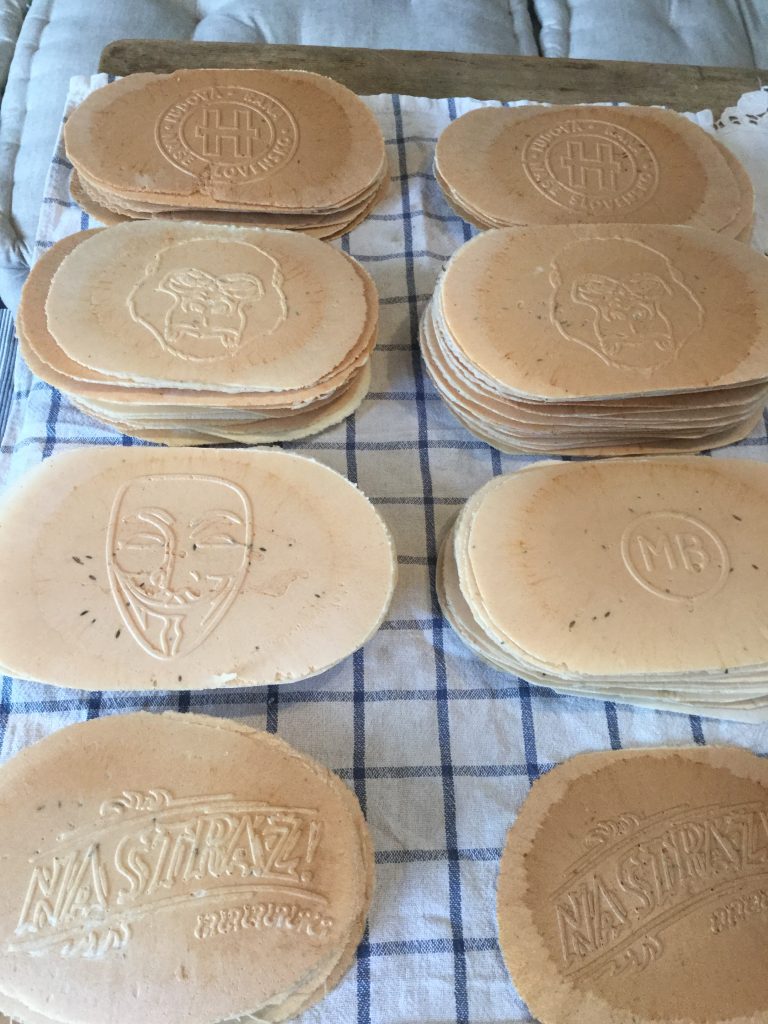
The aim was to draw attention to the appropriation of elements of folk culture by the far-right government in the process of creating nationalist narratives that dangerously resembled the rhetoric of the state ruled by Tiso. After the Minister of Culture made her famous statement in November 2023 defining the principles of cultural policy—“Slovak and no other”—mass protests began, including among groups associated with folk institutions chanting “not in our name.”
A similar rhetorical framework has been employed under Viktor Orbán’s regime in Hungary, which renders the emphasis placed in the fifth edition of the OFF-Biennale Budapest (2025) on the contributions of Roma culture to the Hungarian art scene particularly significant. The Biennale included works by Gypsy Criminals, a project initiated by Norbert Oláh, who also runs Bura Gallery, a space for progressive Roma art that explores social problems in the community. At the same time Országút Gallery hosted an exhibition by Norbert Oláh, entitled Gypsies in Space.
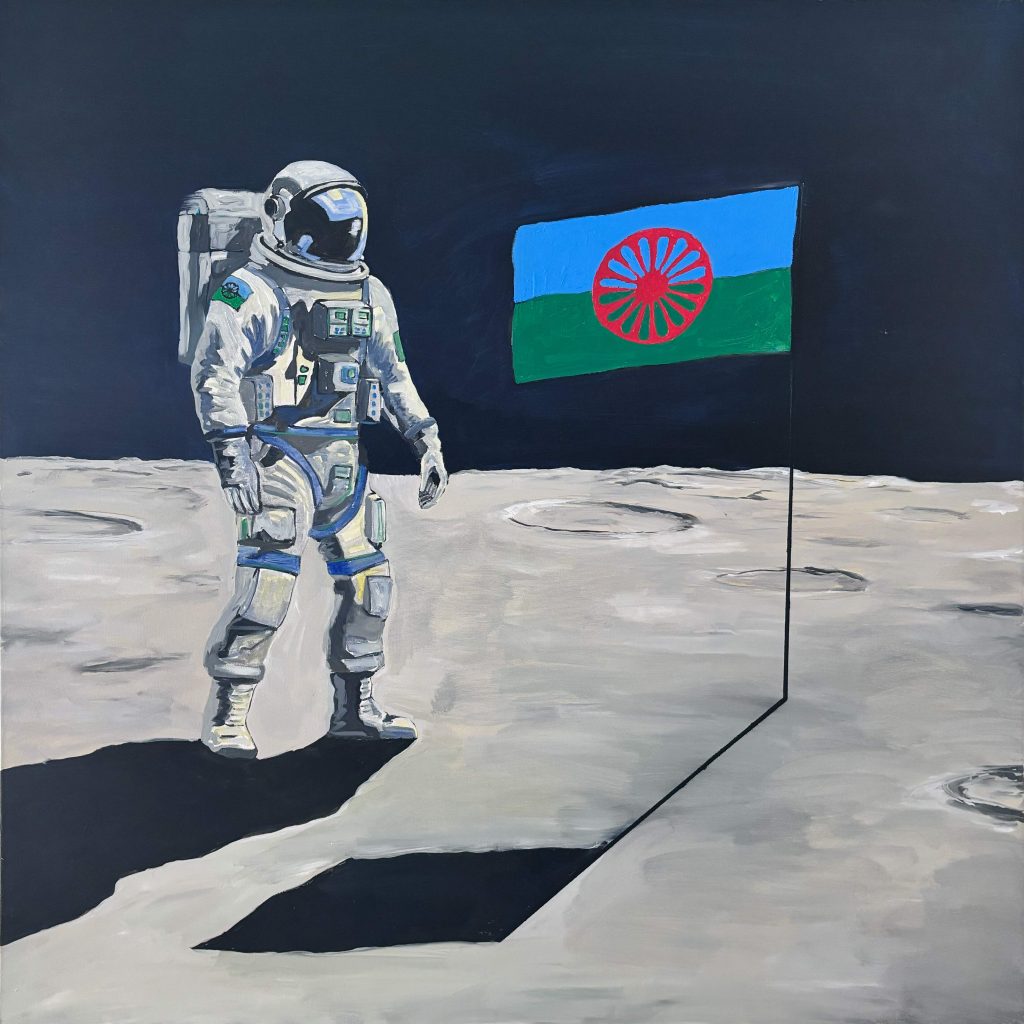
It consisted of a series of paintings (Fig.5.) whose main motif was Roma people in space, and the image advertising the exhibition depicted a Roma cosmonaut just after he had erected the Roma flag on the moon. This work focuses on issues important for art in the post-communist region struggling with the product of political transformation in the form of the rise of the ethnic nationalist tendencies. What at first glance appears to be self-ironic is in fact justified sarcasm, a critique not only of American imperialism, but also of the naturalized and neutralized structure of the division of the world into nation states, for which there seems to be no alternative in the form of other types of collective identity. Roma identity is subject to severe exclusions and attacks in Hungary and the region, which are not only ethnic but also class-based, in the meaning that most of the Roma population live in deep poverty and segregation in horrible conditions especially in the eastern part of the country. An important context for the work is Donald Trump’s victory in the US presidential election six months earlier (November, 2024), which resulted in the reduction of the democratic narrative to a conglomerate of national values and the apotheosis of the free market. As a representative of a collective identity that does not function within such specific paradigms, Norbert Oláh’s work has the social and ethical legitimacy to offer such criticism. The OFF-Biennale is an event sensitive to the ethnic, gender, and class diversity. As part of the Biennale, the exhibition curated by Kata Oltai The Day After Tomorrow, Everything Will Change in a small Pharmacy, a branch of the Semmelweis Medical History Museum in Budapest’s district 8, included the installation by Nóra Zsófia Demeter. In the exhibition where sex workers are rampant, is dedicated to historical methods of contraception and the exhibition of the artist’s bodily remains that were caught in the drain, hair and fragments of skin. The work is therefore a reflection on what is lost in the process of identity construction, on what fills the sewers, which are an important source of knowledge about what escapes social and medical sciences. If this work were exhibited in Poland, its meaning would be reduced in public debate to women’s rights. In Hungary, however, women’s rights have not been infringed so radically. There has never been an attempt to introduce a law depriving women of the right to abortion in cases of severe fetal defects, as was the case in Poland at the turn of 2020 and 2021, when abortion laws were tightened. A common taboo area for both countries is the exclusion of economic causes of abortion, poverty is either subject to secondary victimization or is invisible and essentially taboo, effectively concealing the class aspects of the problem. Therefore, Demeter’s work resonates with both feminist and class issues, which makes the meanings they generate subtler.
The OFF-Biennale Budapest was also an opportunity for the curators to see how social and political issues important for Hungarian artists resonate in the context of art in Post-communist Europe. For example, Florin Flueras, one of the most politically active Romanian artists decided to come to the event on his own to present his performance, Unhere parallel with but independent of the OFF-Biennale Budapest. It is a series in which the artist and performers invited by him perform a state of dissociation, experiencing emotional and physical states unrelated to their surroundings and the context of the performance. Dissociation is one of the psychological defence mechanisms. Flueras’ performance in Budapest took place just a few days after the first round of the presidential elections in Romania, won by the leader of the far-right Alliance for the Unity of Romanians (Alianțapentru Unirea Românilor, AUR) who was supported by the majority of voters, defeating the pro-European mayor of Bucharest, Nicușor Dan. These were, in fact, repeated elections after the Romanian Constitutional Court annulled the electoral process in accordance with a report by the Supreme National Security Council, which pointed to external interference in the elections. Flueras then brushed up two of his series, Unhere and The Presidential Candidate, which he began after Traian Băsescu, a former member of the Communist Party and member of the Alliance for Truth and Justice, won the Romanian presidential election in 2009. The mechanism behind The Presidential Candidate was similar to that of Unhere—the titular candidate ran his campaign at the wrong time and in inappropriate places. What’s more people playing the candidate changed. One of the events was Postspectacle Shelter in 2012, in the former House of the People, which houses the Romanian Parliament and the National Museum of Contemporary Art. The artist invited homeless people who visited vernissages for free food and alcohol to the event. As Alina Popa recalls, “The homeless who usually come to openings for a snack and a drink (called Pișcotari in Romanian) were always treated as inferior because they preferred food to emotional, cathartic states of mind allegedly stimulated by art. There is an emancipatory potential in the subjectivity of this type of spectator (embodied by the homeless), who does not privilege catharsis over bodily needs. In a society ruled by economic laws, the politics of food is well entangled with a politics of emotions.”[16] The artist uses incongruity and inadequacy as a tool to expose the inadequacy of socially engaged art in a market system. Flueras triggers an ostentatious mechanism of corruption in order to point out the dysfunctionality of the system. In 2012, the European Commission issued a negative opinion on the rule of law in Romania in the context of the ongoing constitutional crisis in the country, which was the result of a dispute between the president and the prime minister, pointing out Romania’s problem with corruption. Other actions in the series included formulating demands concerning the situation in Romania from Vienna, the seat of the IMF, in accordance with the principle of doing so in the place where decisions are actually made, and bringing Roma people into galleries in response to Băsescu’s anti-Roma statements. During the presidential elections in 2025, Flueras continued to perform The Presidential Candidate in changing contexts. The dissociation that forms the axis of the Romanian artist’s work can be considered typical of the situation in the region. On the one hand, it is experienced by people attached to the format of national identities, and on the other, it is an integral part of the prevailing model of art with its previously described mythology. It takes the form of a false consciousness among art workers who are unaware of their own working-class identity and rely on market practices that include rhetoric about genius, talent, excellence and uniqueness.
An important addition to the afore-mentioned events in Post-Communist Europe is the political situation in Serbia and its effects on cultural policy. Around the time of the rigged elections in Romania, in November 2024, a construction disaster occurred in Novi Sad, killing sixteen people, a six-year-old child among them. The student protests that have been ongoing since then and have spread throughout Serbia were initially aimed at holding those responsible for the disaster accountable and exposing the mechanisms of corruption behind it. As Serbian curators Marijana Cvetković and Vida Knežević point out, “The ruling regime has significantly amplified the sociopolitical processes that have been unfolding in Serbia since the dissolution of Socialist Yugoslavia, the wars of the 1990s, and the widespread pauperisation and privatisation that persisted into the 2000s. These developments have been further accelerated by the imposition of neoliberal reforms. Tailored to Serbia’s position as a peripheral European country, this sort of capitalist system entails a regime of economic and political pressures that enable neocolonial relations, primarily in the form of cheap labor by workers disincentivized to fight for their fundamental rights.”[17] The protests were accompanied by a boycott of capitalist institutions, refraining from spending money, etc. Mass student strikes led to an education reform program. As argued by Cvetković and Knežević, the protests fostered practices of solidarity and self-organization among cultural workers.[18] Although their response to the protests consisted more of inaction than action, as cultural sector workers took up the slogan proclaimed by the students—”Students in Blockade,” “Workers on Strike”—several exhibitions were held in response to the collective blockades. There were connecting exhibitions in Novi Sad at the Shok Gallery prepared by students from the Bogdan Shuput Secondary School of Design, at the SULUV Gallery, with some works by students of stage design at the Faculty of Theatre and New Arts, and at the AUNS Gallery, where the largest number of works were shown. The exhibitions revealed the collective subject of the strike as essentially united, with fluid internal boundaries, it was impossible to distinguish students, artists and even workers. Two types of works were shown during the exhibition, works supporting the strikes and blockades in the form of a synthesized visual language of a performative nature. These works either came from the protests or were created with them in mind. The second type of works can be described as “contemporary socialist realism,” an accumulation of sleeping bags, concrete slabs, but also banners. The exhibition did not speak about protests, but through and with them.
As I argued before, “Contrary to its predecessor, the new socialist realism is not entangled within the symbolic register of its means of expression, but rather emphasizes its materiality.” It does not rely on a specific form, so it is futile to look for common features with historical socialist realism in this respect. The criterion here would rather be a departure from superstructural aspects towards basic ones, the former are demonstrated as material and become de facto part of the base. An important feature here is resistance to becoming a basis for capital accumulation. Nor is it art that functions within the canon, because the accumulation of symbolic capital is closely linked to market mechanisms. This can be achieved through the cheapness of the material, poor workmanship or performativity. In essence, it would be an art form susceptible to base analysis, one whose fundamental generators of meaning are anchored exclusively in elements of the base.
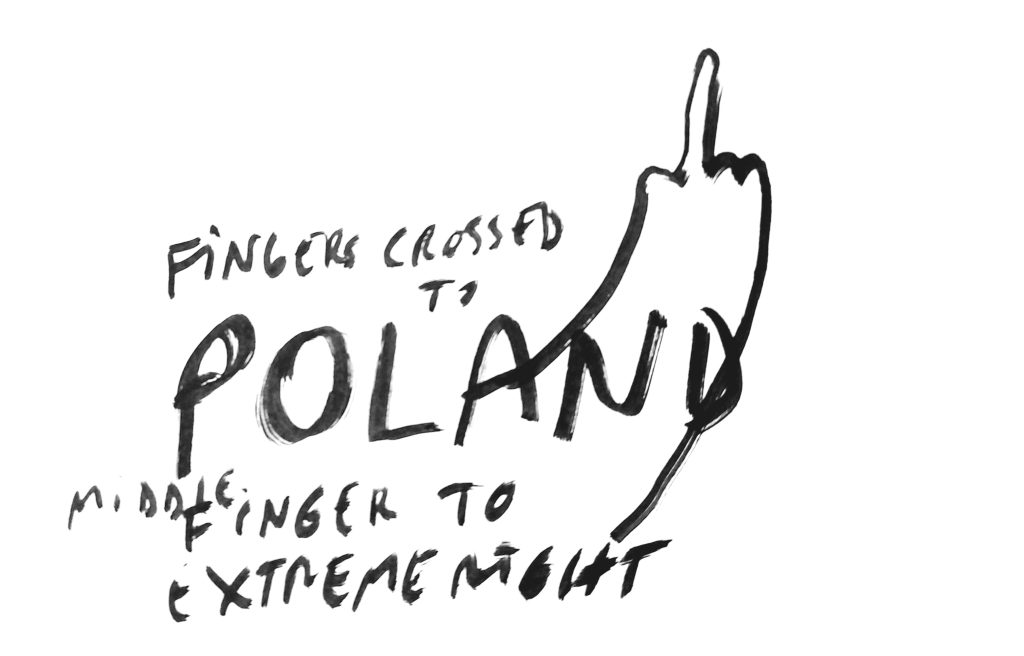
This internal fluidity of the borders of a solidary subject is also visible within the former Eastern Bloc. Romanian artist Dan Perjovschi became involved in supporting political forces in Poland seeking to remove the extreme right from power by creating a series of drawings, among which the most direct reference to this solidarity is the word POLAND (Fig.6.) with the O in the form of a target and the inscription “will affect us all.” However, I would like to draw attention to another drawing that I find particularly important, as it was created without a clear idea or joke, which usually dominates the artist’s work. It depicts a hand showing a middle finger and is captioned “fingers crossed to Poland, middle finger to extreme right.” This performative departure from the artist’s usual practice in the form of a synthetic and accurate punchline, towards radical political commentary, shows the extent of the artist’s involvement in the political situation, which he perceives partly as his own.
The point of this text could effectively be summed up in this way, but I would like to draw attention to the local situation in Poznań, home of a large group of contemporary Belarusian artists who have found a relatively safe shelter here. Belarusian artists Sergey Shabohin and Aleksei Borisionok run the Grey Mandorla Gallery, which is among the most interesting art galleries in Europe. These artists queer the language of politically engaged art in the face of the fact that in Belarus the leftist narrative, which operates with the concept of the collective, is instrumentalized by the government, and they do not see the nationalist narrative as an alternative. I also consider their works exhibited in the Gallery among examples of “contemporary socialist realism,” as they clearly depart from representation. They present not only social and political problems, but also their own economic conditions. Equally important is the DOMIE Gallery, whose program focuses on social and class issues and actively promotes the Belarusian art scene. Belarusian art is in an ambivalent position. Belarusian artists, at the forefront of the intensified protests in Belarus in 2020–2021, used to be perceived as heroes of the revolution, and after Lukashenko’s support for Putin’s invasion of Ukraine, they are now seen almost as potential spies. The status of these people, who risk their lives by engaging in political activity, is nothing like the attention and support that the Ukrainian artistic community would rightly deserve. Just an example, there were excellent exhibitions at Grey Mandorla in recent years which I was unable to promote via social media as the artists feared persecution. Even in Poznań, they are being followed by the secret services, and the consequences of linking their names to political art could be disastrous for those who travel between Belarus and Poland. That is why I cannot mention the name of the outstanding Belarusian artist. The artist showed a series of postcards officially issued by the Belarusian postal service, embroidering letters to people arrested during what was described as a wave of revolution in Belarus in black thread. The artist embroidered slogans taken from propaganda. It operates with a structure essentially similar to the one used by Shabohin and Borisionok, it does not involve constructing an antithetical alternative to the language of propaganda, but rather a subversive, engaged commentary that reveals the problems of that language. Belarusian artists employ dialectical strategies, resisting the temptation to create binary oppositions to authoritarian governments, which are often simply appropriated by the neoliberal model of culture. The latter is no less authoritarian than the political right. Authoritarian capitalism and nationalism are, as philosopher Rastko Mocnik argues, two sides of the same coin.[19]
Coda. Almost two years ago, just before the parliamentary elections in Poland, my colleague and one of the most recognizable Belarusian artists, Raman Tratsiuk, persuaded me to sign up as a social observer for the elections. He made me realize what a great privilege it is to be able to vote, which he himself, having lived in Poznań for many years and speaking perfect Polish, did not have. Politically engaged art in post-communist Europe today is building new models that are not so much artistic as ethical, making us aware of our shared responsibility for one another.[20]
Magdalena Radomska is a Post-Marxist art historian and historian of philosophy, Assistant Professor at Adam Mickiewicz University in Poznań, Poland. She is the founder and head of the Piotr Piotrowski Center for Research on East-Central European Art. She has been awarded scholarships at the Courtauld Institute of Art in London, the Hungarian Academy of Sciences, ELTE, and CEU in Budapest. Her monograph The Politics of Movements of Hungarian Neoavantgarde (1966–80) was published in 2013. She has received research grants from the Getty Foundation, Erste Foundation, the Visegrad Fund, The Clifford and Mary Corbridge Trust, and the Polish National Science Center. Her work has been published by Thames & Hudson, Wiley-Blackwell, and Routledge. Her current research focuses on post-Communist art in East-Central Europe and artistic critiques of capitalism. Her forthcoming book, The Plural Subject: Art and Crisis after 2008, will be published by Routledge.
[1] Boris Arwatow, “Proletariat i sztuka lewicowa,”in Praca i wypoczynek, ed. K. Gufrański (Gdańsk, 2012): 199.
[2] Arwatow, Proletariat i sztuka lewicowa, 201.
[3] Arwatow, Proletariat i sztuka lewicowa, 201.
[4] Piotr Piotrowski, Avant-garde in the Shadow of Yalta: Art of Central and Eastern Europe 1945–89 (London: Reaktion Books, 2011), 14–19.
[5] Hans Abbing, Why Are Artists Poor? The Exceptional Economy of the Arts (Amsterdam: Amsterdam University Press, 2002), 263-266; Julia Bryan-Wilson, Sztuka a praca, [in:] Czarna księga polskich artystów, ed. K. Górna, K. Sienkiewicz, (Warszawa: 2015): 64–65.
[6] Kuba Szreder, “Praca, praceisztuka. O różnicachmiędzypraca ̨ pracowników sztuki a wytwarzaniempracartystycznych,” in Czarna księga polskich artystów, ed. K. Górna, K. Sienkiewicz, (Warszawa: Wydawnictwo Krytyki Politycznej, 2015): 45–61.
[7] Magdalena Radomska, “Not Horizontal Enough: Horizontal Art History with Marxist Restrictions,” in Horizontal Art History and Beyond, Revising Peripheral Critical Practices, eds. Agata Jakubowska, Magdalena Radomska (London: Routledge, 2022), 118, 123–33.
[8] Radomska, “Not Horizontal Enough,” 132.
[9] Concepts of base and superstructure are discussed by Karl Marx in A Contribution to the Critique of Political Economy, Marxists.org 1999, https://www.marxists.org/archive/marx/works/1859/critique-pol-economy/index.htm.
[10] Radomska, “Not Horizontal Enough,” 132.
[11] https://offbiennale2025.hu/en/events/
[12] Roland Barthes, Mythologies (New York: Farrar, Straus & Giroux,1972), 146.
[13] Nick Thorpe, The man who Thinks Europe has been Invaded, BBC, https://www.bbc.co.uk/news/resources/idt-sh/Viktor_Orban [acess: 18th of June, 2025].
[14] Irene Pavesi, Jennifer J. Laourou, Sanyay Sethi, Early Warning: The Politicization of Arts and Culture in Slovakia (Bratislava: Artistic Freedom Initiative and Open Culture! 2025).
[15] Pavesi, Laourou, Sethi, Early Warning, 65.
[16] Marijana Cvetković, Knežević Vida, Mass Student Protests in Serbia: The possibility of different social relations, in:’internationale, https://internationaleonline.org/contributions/mass-student-protests-in-serbia-the-possibility-of-different-social-relations/ (June 18, 2025].
[17] Cvetković, Knežević, Mass Student Protests in Serbia
[18] Cvetković, Knežević, Mass Student Protests in Serbia
[19] Rastko Močnik, “What is New in the New Forms of Nationalism? The Case of Hungary,” in Xenophobia, Identity and New Forms of Nationalism, ed. Vladimir Milisavljević and Natalija Mićunović (Belgrade: Institute of Social Sciences, 2019): 22–38.
[20] I would like to thank Edit András and Hedvig Turai for being my guides during OFF-Biennale Budapest, to Cristina Stonescu, Daniel Grúň & Jelena Vesić for help in research.